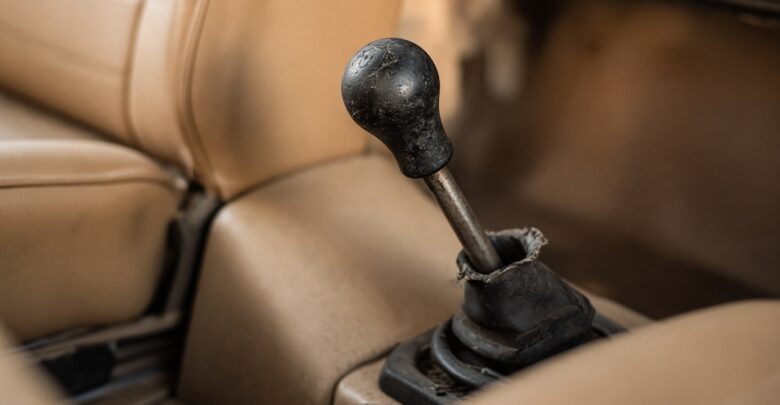
R is familiar. The numbered gears make sense. But what is G doing at the bottom of this old shift pattern? The G gear meaning is connected with the German word Gelände, meaning terrain: it identifies a very low crawler gear in a familiar example, the Volkswagen T3 Syncro.
It is not a secret extra cruising gear, and the letter does not mean the same thing on every control in every vehicle. Context matters. The source picture gives us a specific kind of old manual shift layout to discuss, not a universal translation for any G button you might find.
The source article also links the idea broadly with Mercedes-Benz off-road history. That origin claim is not established by the evidence checked here. The clearer, supported example is the T3 Syncro’s transmission, so we will keep the explanation anchored there.

The G Gear Meaning in a T3 Syncro
R J Engineered Solutions’ VW gearbox guide describes the 094 Syncro gearbox as G plus four forward gears and reverse. It explains G as the terrain gear, much lower than the ordinary first gear.
Brickwerks’ T3 Syncro gearbox data separately lists a Gelände gear alongside first through fourth and reverse. That distinction helps make sense of the unusual knob layout.
The ordinary road gears have not disappeared. The low G position gives the vehicle another specialized ratio for moving slowly. Describing the system as four road gears plus a crawler gear is clearer than assuming the extra position behaves like a higher fifth gear.

Low Gear Is About Slow Movement, Not Extra Speed
A lower gear ratio lets the engine turn more relative to the wheels. That can provide greater torque multiplication at the wheels while the vehicle moves slowly, rather than asking the driver to maintain a high road speed.
Think of the difference between a job that needs controlled movement and one that needs comfortable cruising. The crawler gear belongs to the first category. Its purpose is not to make the vehicle faster on a highway.
That basic idea does not replace the vehicle’s operating instructions. The usable conditions, limits, and method of selection depend on the actual transmission. A general explanation of ratios cannot tell you exactly when or how to move an unfamiliar lever.
Why an Off-Road Vehicle Might Need It
Rough ground can call for careful, low-speed progress. A specialized low gear can help the vehicle move without the same road speed associated with its usual gears.
However, gearing does not manufacture grip where none exists. Tires, the surface, the slope, the vehicle’s condition, and the driver’s decisions still matter. A letter on a knob is not a guarantee that a route is safe or passable.
The sensible takeaway is that the feature serves a particular job. It is not an invitation to test a difficult track just because the vehicle appears to have more capability than an ordinary car.

Do Not Confuse It With a Universal Low-Range System
Different vehicles achieve low-speed capability in different ways. A crawler position in a manual gearbox is not automatically the same arrangement as a separate transfer-case control or another vehicle’s low-range selector.
The words people use casually can blur those differences. “Low gear” may describe a general function while hiding important mechanical details. The specific vehicle manual is the place to resolve those details.
Likewise, do not assume G means a differential lock. A gear ratio and a system controlling how drive is distributed are different topics. A single photograph cannot tell you the full equipment or condition of a particular van.

A Note About the Source’s History Claim
The original page connects G with the German word for terrain and with military off-road vehicles associated with Mercedes-Benz. The word connection is understandable, but it does not by itself establish the origin of the pictured control.
The gearbox references checked here directly document the Volkswagen Syncro example. They do not prove that the photographed knob traces its design to the specific military history described in the source.
Rather than repeat an appealing origin story as fact, this article separates the supported explanation from the unverified historical link. Knowing what a control does is useful even when a dramatic account of its ancestry remains unsupported.
The Picture Is a Clue, Not a Full Identification
The source layout has four numbered forward positions plus G and R. That fits the kind of four-plus-crawler arrangement under discussion. It does not give us a chassis number, gearbox code, or maintenance record.
A replacement knob could also fail to match the vehicle beneath it. That is a general reason not to rely entirely on whatever diagram happens to be attached to an old lever.
If you are identifying a real vehicle, use its records and appropriate technical help. The image can start a question, but it should not finish a mechanical inspection. This article does not identify an individual owner’s vehicle from the photograph.

What to Ask Before Driving Something Unfamiliar
Ask the owner or a qualified professional which gearbox is installed, whether the diagram is correct, and where the operating instructions can be found. Those are better questions than experimenting with positions while the vehicle is moving.
If the controls do not behave as expected, stop in a safe place and get help. Do not force a selection or interpret resistance as a challenge to overcome.
For an older vehicle, condition matters as much as the original design. Wear, repairs, or modifications can change what needs attention. A short online explanation cannot establish that a decades-old transmission is ready for a demanding trip.

Why the Small Letter Is So Interesting
A familiar object becomes a puzzle when it contains one unfamiliar mark. Most drivers recognize the idea of a shift pattern, so the unexpected G stands out immediately.
The answer also tells a useful design story without needing an invented legend. A vehicle built for a different kind of work can have controls that look odd from the perspective of everyday road driving.
The G gear meaning is therefore practical: in the documented Syncro example, terrain-focused low-speed gearing sits beside the normal road ratios. The mystery is not an extra performance trick. It is a reminder that a control makes sense when you understand the job it was designed to do.
There is another helpful distinction: a gear’s purpose is not a claim that it suits every difficult situation. A very slow ratio may be useful in one setting while other limits make the same route inappropriate. Ground clearance, recovery options, weather, and the condition of the route cannot be read from the G marking. Learning the name of the gear is therefore a starting point for understanding equipment, not a permission slip to use it wherever the road looks challenging.
For a puzzle shared online, the careful answer can stay short: G refers to terrain-focused crawler gearing in the documented Syncro example. If someone asks about a different model, identify that model before extending the explanation. Similar letters can be reused for different functions, and an old control may have been modified. Keeping the answer specific avoids turning one interesting piece of mechanical history into a universal rule that fails on the next vehicle.
The supporting generated pictures are illustrative rather than identification evidence. A generic vintage van cannot confirm the make of the original photograph, and a photograph of gears cannot establish a particular ratio. The cited technical descriptions carry that part of the explanation; the artwork simply makes the topic easier to picture.
Thanks for taking a slow look at an old gear-stick mystery. This is entertainment and general mechanical information, not professional repair or driving advice. For a real vehicle, follow its correct handbook and ask a qualified expert before using unfamiliar controls.