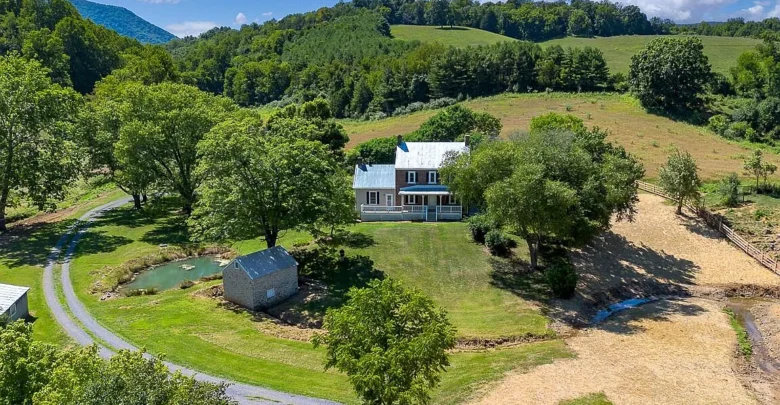
Every so often a property comes to market that is not really a house at all, but a landscape with a house standing in the middle of it. At 504 Springbranch Road in Lexington, Virginia, an 1880s farmhouse sits at the foot of the Shenandoah Mountains on 220.6 acres of rolling pasture, mature woodland and spring-fed creek. Listed at $1,550,000 and described as priced at appraised value, it comes with a guest house, a spring house, a pole barn, a pole shed and roughly $175,000 in standing timber value.
220 Acres at the Foot of the Shenandoah Mountains
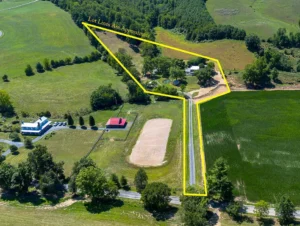
The scale here is what separates this listing from almost everything else in the Virginia market. The property spans 220.6 acres and is sold as three parcels together, with two of them providing road frontage on both sides of Springbranch Road.
- Parcel A, Tax ID 94-A-1: 128.32 acres
- Parcel B, Tax ID 84-A-29: 92.1 acres
- Parcel C, Tax ID 94-1-1B: 0.18 acres
The sellers have stated clearly that they will not divide the parcels and prefer to sell all three together, with the house offered as-is. That is worth understanding upfront, because it shapes who the right buyer is. This is not a subdivision play. It is a single estate purchase for someone who wants the whole valley.
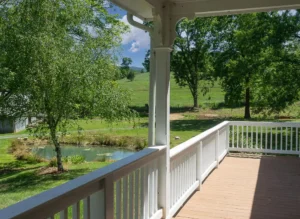
The terrain is a genuine mix rather than one monotonous type. Lot features include pasture, rolling slope and woodland, with residential vegetation listed as crops and mixed growth. Waterfront features include a creek, a pond and a stream. Fencing runs a combination of barbed wire, split rail and partial enclosure, consistent with a working agricultural property. Zoning is A2, the agricultural designation.
The Main House: 1880s Farmhouse, Thoughtfully Updated
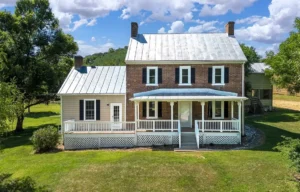
The main residence offers 3 bedrooms and 1.5 bathrooms across 2,310 square feet on two levels. Built in 1880, it carries the architectural signatures of the period, including tall ceilings and original hardwood floors, while the systems and finishes have been brought current.
Construction materials are a mix of brick, frame, HardiPlank siding and plaster, under a metal roof. The metal roof is a meaningful detail on a property of this age, since it typically outlasts asphalt shingles by decades and often earns favorable treatment from homeowners insurance carriers who otherwise underwrite pre-1900 construction cautiously.
The Chef’s Kitchen
The kitchen has been fully renovated with custom cabinetry, granite countertops, a kitchen island and high-end ZLINE appliances. Included appliances are the stove, range hood, refrigerator, dishwasher, an electric water heater and a stacked washer and dryer. A pantry supports the space.
Both bathrooms have been recently updated, and the half bath sits on the first floor with the full bath and shower upstairs.
The Living Spaces
The interior features bookcases and built-in cabinetry, a separate formal dining room, high ceilings and two masonry wood-burning fireplaces. Flooring runs tile and wood throughout. There is a bedroom on the main level, which adds real long-term flexibility to a two-story historic home.
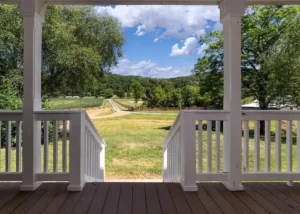
A light-filled sunroom captures mountain views year round, and a full country front porch runs across the front of the house. On a property with this much land, the porch is not a decorative feature. It is the primary living room for half the year.
Water, Power and Remote Work Capability
This is where the property crosses from scenic into genuinely self-sufficient. The home is served by a spring-fed water system with double filtration and UV treatment, which delivers clean water independent of any municipal supply. Sewer runs to a septic tank. Heating comes from an electric heat pump with central air conditioning.
High speed internet is available and the home is wired for data, which for a property twenty minutes from town is the detail that makes full-time residence realistic rather than aspirational. Remote work, video calls and cloud-based operations are all viable here, which is exactly what has driven the surge in demand for large rural estates over the past several years.
The Outbuildings
Beyond the main house, the property includes a guest house, a spring house, a pole barn and a pole shed, with barns and stables listed among the additional structures. The guest house alone changes the financial calculus, offering options for extended family, farm staff, a studio or an income-producing rental.
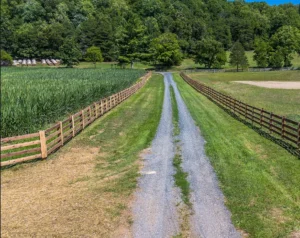
Parking is via an unpaved driveway with uncovered spaces, consistent with the working farm character of the property.
The Timber Asset
One number in this listing deserves special attention. Timber value on the property is estimated at approximately $175,000, and the sellers have completed a recent full forestry plan available by request.
That forestry plan is not a formality. It is a professionally prepared document that inventories species, volume, age class and recommended harvest schedule. For a buyer, it converts a vague notion of woodland into a quantifiable asset with a management timeline. Standing timber can be harvested selectively over decades, providing periodic income while the land continues appreciating.
Buyers should request the plan during due diligence, verify the cruise date, and discuss the tax treatment of timber income with a CPA. Timber sales are generally taxed as capital gains rather than ordinary income when the property is held long enough, which is a meaningful advantage worth structuring correctly from the start.
The Financial Picture
The current asking price of $1,550,000 works out to $671 per square foot on the house alone, though that figure is misleading on a property where the land carries most of the value. The Zestimate sits at $1,424,100 with an estimated range of $1.35 million to $1.50 million.
Price history shows a clear downward trajectory. The property was listed in June 2025 at $1,695,000, reduced to $1,645,000 in July, then reduced again in September to the current $1,550,000. Combined with more than two hundred days on market, that pattern typically signals a motivated seller and meaningful negotiating room, particularly in a niche where the qualified buyer pool is small by definition.
Tax assessed value is $1,058,100 with an annual tax amount of $2,332. For a property of this size, that is an extraordinarily low carrying cost, and it reflects Virginia’s land use taxation program, which assesses qualifying agricultural and forestal land at its use value rather than its market value. Buyers should confirm the land use enrollment status directly with Rockbridge County, since removing land from the program can trigger rollback taxes covering several prior years.
Property Snapshot
- Address: 504 Springbranch Rd, Lexington, VA 24450
- List price: $1,550,000
- Bedrooms: 3
- Bathrooms: 1.5
- Interior area: 2,310 square feet
- Lot size: 220.6 acres across three parcels
- Year built: 1880
- Style: Farmhouse, two stories
- Roof: Metal
- Zoning: A2 agricultural
- Heating: Electric heat pump. Cooling: Central air
- Water: Spring-fed with double filtration and UV. Sewer: Septic
- Fireplaces: 2, masonry wood burning
- Tax assessed value: $1,058,100
- Annual property tax: $2,332
- Estimated timber value: approximately $175,000
- HOA: None
Financing a Large Acreage Estate
Financing 220 acres is a different exercise from financing a house, and buyers who approach it like a standard purchase often hit walls late in the process.
Conventional mortgages become complicated at this scale because most lenders selling loans to Fannie Mae or Freddie Mac apply acreage limits and require the land value to represent a reasonable proportion of total value. On a property where the land carries most of the worth, that test frequently fails.
The practical routes are farm credit lenders and portfolio lenders. Farm Credit System institutions specialize in agricultural real estate, understand timber and pasture valuation, and routinely finance properties of this size. They typically require twenty to thirty percent down with terms structured around agricultural income cycles. Regional portfolio lenders that hold loans on their own books offer similar flexibility.
A jumbo mortgage is the third path for buyers financing primarily against the residence, though appraisal remains the challenge since comparable sales for 220-acre estates are scarce. Buyers should expect the appraisal to take longer and should build extra time into the contract.
Government-backed programs generally do not apply here. FHA and VA loans carry owner-occupancy and property standard requirements that a working farm sold as-is typically will not satisfy, and USDA rural development loans, despite the rural setting, impose income limits far below what a $1.55 million purchase implies.
Insurance on a Historic Farm Property
Insuring this property requires a farm and ranch policy rather than a standard homeowners policy. Farm policies cover the dwelling, the outbuildings, farm equipment and liability arising from agricultural use, all of which a residential policy excludes or limits severely.
Buyers should request guaranteed replacement cost coverage on the 1880 dwelling, since standard replacement cost calculations based on modern materials will not rebuild original plaster and period millwork. Separate coverage should be discussed for the guest house, the barns and the stables. Flood insurance should be quoted independently given the creek, pond and stream on the property, as no standard policy includes flood damage.
Due Diligence Checklist
- Request the full forestry plan and verify the timber cruise date
- Confirm land use taxation enrollment and calculate potential rollback exposure
- Order a boundary survey covering all three parcels
- Test the spring water system output, filtration and UV treatment
- Inspect the septic system and confirm capacity
- Verify mineral rights, easements and any recorded rights of way
- Hire an inspector experienced with pre-1900 construction
- Confirm A2 zoning permits any intended use, including short-term rental of the guest house
Location: Lexington and Rockbridge County
The property sits approximately twenty minutes from historic Lexington and thirty minutes north of Natural Bridge. Lexington is home to Washington and Lee University and the Virginia Military Institute, giving a small town of its size a cultural and economic base most rural Virginia communities lack. Schools serving the property include Maury River Middle and Rockbridge County High.
That proximity is the balance point of the entire listing. Far enough out for genuine privacy across 220 acres, close enough in that groceries, restaurants, medical care and an airport connection remain a manageable drive.
Final Thoughts
Properties combining an updated historic farmhouse, a guest house, working barns, pasture, managed timber, spring water and 220 contiguous acres do not come to market often, and when they do they rarely stay available for a buyer to think it over. At $1,550,000 after two price reductions, with an appraised value backing the number and roughly $175,000 in standing timber included, 504 Springbranch Road offers something the Virginia market produces only a handful of times each year. As the listing itself puts it, this is the kind of place you visit and simply do not want to leave.





From ZILLOW