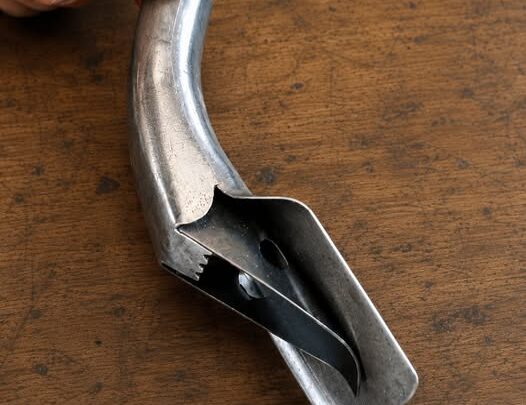
If you found a strange metal tool in your dad’s garage, would you know what it did—or assume it belonged in a museum? One vintage tool has confused plenty of modern eyes because its sharp edge, handle, and curved channel look like parts of several different gadgets. The surprising answer is much simpler: it was likely made to open old motor-oil cans and help pour the oil without a mess.
Once you understand the container it was designed for, the odd shape suddenly makes sense.
The Strange Tool Was Built for an Old-Fashioned Oil Can
Before today’s plastic bottles with screw caps became standard, motor oil often came in metal or composite cans. Those cans did not simply twist open. You needed a tool that could pierce the top and create a controlled opening.
That is where the reusable oil-can spout came in.
The pointed section punched through the can. The channel or hollow portion helped direct the oil. Instead of grabbing separate tools to open and pour, a mechanic or service-station attendant could use one compact piece of hardware.
And yes, that sharp point had a job.
Why Mechanics Kept One Nearby
Imagine checking an engine and discovering that it needs another quart of oil. Today, you grab a plastic bottle, twist the cap, and pour.
Older service routines were more hands-on. A worker would take a sealed can, use the piercing end to open it, position the spout, and add the oil to the engine.
Because the tool could be reused, it made sense to keep it in a toolbox or service area. For busy garages and full-service stations, a sturdy accessory that handled the same task repeatedly was worth keeping around.
Pro Tip: If you discover one in an old toolbox, picture it attached to the old can it was designed to open. That mental image often makes the strange shape obvious.
The Missing Piece Is the Container
Modern packaging has trained us to expect the opening mechanism to be built into the package. A bottle has a threaded neck and removable cap.
Older oil cans separated those jobs.
The container needed an external tool to create an opening, while the accessory helped control the flow. Remove the old can from the picture and the accessory suddenly looks bizarre.
The tool did not become complicated. The world around it disappeared.
Why You Rarely See These Tools Today
Packaging changed, and the tool lost its reason to exist.
As motor oil moved toward plastic bottles, manufacturers added screw caps and shaped necks that made opening and pouring much easier. The customer no longer needed to puncture a metal lid or attach a reusable spout.
That does not mean the old design was bad. It solved a problem that modern packaging eventually solved for you.
When a manufacturer builds a function into the product, the separate accessory can disappear.
How to Identify Your Mystery Tool
If you have one sitting in a drawer, don’t rely on a single visual clue. Several features together make the identification stronger.
- A pointed or cutting end: This suggests the tool was intended to pierce a thin container top.
- A channel or pouring section: A defined path for liquid is a useful clue when paired with a piercing point.
- A gripping or leverage area: The user needed control and pressure to penetrate the can.
- Oil staining or residue: This can support the theory, although residue alone does not prove its purpose.
- Stamped markings: Brand names, patent numbers, logos, or model information can be especially helpful.
However, don’t stop at “it looks like the picture.” Old industrial tools can share similar shapes. Matching the mechanism, markings, and dimensions is better evidence.
Photograph It Before You Clean It
Collectors and curious homeowners often make one mistake: they polish first and investigate later.
A wire brush or strong cleaner can erase clues that identify an old tool. Original markings, plating, paint, and surface wear may be more useful than a shiny finish.
Instead, photograph it from several angles, including close-ups of stamped letters, numbers, logos, and patent references.
Then search those markings alongside phrases such as “vintage oil can spout,” “quart oil can opener,” or “automotive oil can tool.” Old catalogs, museum collections, advertisements, and patent records can sometimes reveal the exact model.
Pro Tip: Measure the tool before searching. Its length, width, and piercing-section shape can help separate a genuine oil-can accessory from a similar-looking workshop tool.
Is the Old Tool Worth Anything?
Vintage does not automatically mean expensive. Many automotive tools were mass-produced for daily work, so age alone is not enough to create a high resale price.
Condition, manufacturer, rarity, markings, and completeness all matter. Online asking prices can also mislead because a listed price is not the same as a confirmed sale.
Still, if the tool belonged to your father or grandfather, its personal value may be far greater than its collector price.
The Real Reason Your Dad Might Have Smiled
There is something wonderfully ordinary about an older person recognizing a tool that looks mysterious to everyone else.
Your father may have remembered seeing one at a service station or using one himself. Perhaps he simply knew what it was because these objects were once common.
For someone raised around plastic oil bottles, the tool looks like a miniature machine. For someone familiar with older automotive maintenance, it could be as recognizable as a screwdriver.
What This Tiny Tool Says About Technology
The bigger story is not really about motor oil. It is about how quickly ordinary knowledge disappears.
When packaging changes, the actions surrounding it change too. People stop learning which tool to use, manufacturers stop making replacements, and eventually a familiar object becomes a mystery.
A tool can survive for generations while its purpose disappears.
Preserve the Story, Not Just the Metal
If you inherit one of these tools, write down what you know.
Record who owned it, where it was kept, approximately when it was used, and what you believe it did. Take photographs and save them with those notes.
If you preserve the object physically, clean it gently. Avoid aggressive sanding or polishing until you have documented the markings.
The goal is not to make an old tool look brand-new. Its scratches and worn edges may be part of its story.
The Mystery Finally Makes Sense
So, what was that strange vintage tool hiding in the old toolbox?
If its design includes a piercing point and a pouring channel, it may well be a reusable spout made for older motor-oil cans. Its job was practical: open the container, control the flow, and help mechanics add oil without relying on today’s screw-top bottle.
Once plastic packaging took over, the separate tool became unnecessary. That is how something once familiar enough to sit beside a service-station toolbox could become almost unrecognizable to the next generation.
The object was never strange to the people who used it. It became strange when its world disappeared.
The next time you find an unfamiliar tool in an old drawer, don’t toss it aside. Look for the missing piece—the container, machine, or routine that gave it a purpose. You might be holding a small piece of everyday history.