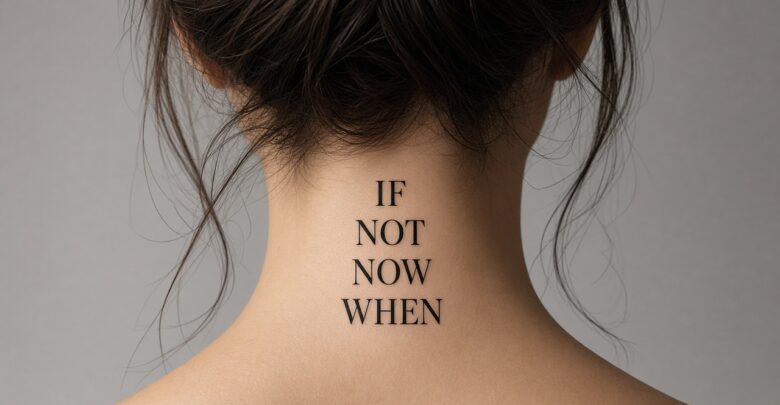
Read the large letters and the tattoo seems to stop halfway through a sentence. Notice the smaller letters, and the viral tattoo meaning becomes much easier to understand: “If not now, when?”
The source image uses a compact arrangement of differently sized letters on the back of a neck. It is a typography puzzle, not a secret warning about the wearer. The phrase is visible in the supplied picture; personal motives and claims about the tattoo’s popularity are not established in the same way.
The source says the tattoo went viral, but provides no verifiable audience count or identified account history in its continuation. We can explain how the lettering reads without claiming millions of documented viewers or pretending to know the person pictured.

The Viral Tattoo Meaning Starts With the Small Letters
The phrase is familiar once you see it, but the layout does not give every word equal visual weight. Large forms dominate while smaller letters sit beside them, inviting a reader to overlook part of the message.
In the top portion, “IF NOT” is combined with the smaller letters that complete “NOW.” In the lower portion, a smaller leading W joins the prominent HEN to make “WHEN.”
Read those pieces together and the intended phrase becomes clear. The punctuation in the plain-text version helps express it as a question; the central task in the picture is recognizing how the letter groups combine.

Why a Familiar Sentence Can Be Hard to Read
Ordinary printed sentences usually give you spaces, a steady reading direction, and letters of similar size. This design changes those cues. A quick look may pick out the largest forms and miss the smaller additions.
That makes the initial reading incomplete, not necessarily impossible. Once someone points out the little letters, you can return to the image and follow the sentence yourself.
There is no need to claim a special neurological trick or a rare ability to explain it. The visible layout is enough. A design can be interesting because it rearranges familiar reading habits, without becoming a scientific test of the people who encounter it.
Read the Photograph, Not Just the Caption
The accompanying caption says people could not work out what the tattoo said. That is a promotional description, not a measured account of how every viewer responded.
Someone who reads it immediately has not disproved that others found it confusing. Someone who needs a hint has not failed a test. The image offers a small decoding task, and different readers may take different amounts of time.
Try tracing the sentence slowly, including the small letters, rather than repeatedly reading only the biggest ones. The explanation should connect to marks actually present in the image. It does not require inventing an absent word or a hidden symbol.

What the Words Can Suggest
As an ordinary phrase, “If not now, when?” asks about postponement. It can be read as a prompt to stop indefinitely delaying something that matters. That is a general interpretation of the sentence, not a confirmed statement from the wearer.
The source does not provide an interview explaining why this person chose it. We do not know whether it relates to work, a relationship, a creative goal, a private memory, or simply a design they liked.
Leaving that unknown is not withholding a secret answer. It is respecting the difference between reading words on skin and knowing the life behind them. The first is possible from the picture; the second would require reliable personal context.
A Prompt Is Not an Order to Be Reckless
You can enjoy the phrase without taking it to mean “act immediately on every impulse.” Some decisions need preparation, consent, money, professional advice, or simply more time.
A useful personal reading might be to choose one sensible next step instead of postponing indefinitely. That step could be gathering information rather than making a large commitment today.
The tattoo does not establish which action is right for anyone who sees it. It is a short sentence, not a complete decision-making plan. Its appeal comes partly from leaving room for readers to connect it with their own circumstances.

What We Cannot Learn From a Tattoo Photo
The image does not reveal the wearer’s identity, medical status, intentions, or character. It does not tell us whether they are safe, dangerous, confident, impulsive, or anything else a stranger might assume.
Nor can the design tell us when it was made or whether it still carries the same personal meaning. Those would be additional claims requiring information the source does not supply.
Avoid turning an interesting visual into a background story about a real person. Describing the lettering is fair. Inventing a crisis, a recovery, a relationship, or a life-changing event to explain it is not.
The Source’s Continuation Is Limited
The next page displays the tattoo image but does not supply a detailed written account from the wearer or artist. Its text does not document a particular social platform, a reliable view count, or a verified explanation of why the design spread.
That limits what this article can honestly claim. The phrase is readable from the image. The supposed scale and history of its popularity remain attributed to the source, not independently confirmed facts.
The repeated source versions show the same underlying composition, so the image appears here only once. Repetition would not create extra evidence, and a slightly different crop would not become a new photograph of the event.

If You Like the Idea, Think About Readability
For a tattoo you might choose yourself, a compact phrase can look different on paper, on a curved surface, and at a distance. Discuss the design with a reputable professional instead of treating a viral screenshot as a complete template.
Ask for time to read the proposed arrangement carefully. Check every word and letter. A clever layout should still communicate what you intend, rather than relying on a caption to repair an accidental omission.
There is no requirement to copy the original. You might prefer a clearer line of text, a different arrangement, or no permanent design at all. Appreciation does not have to become an immediate purchase or an imitation.

The Answer Is Simple Once You Include Everything
The viral tattoo meaning is not a code about the person wearing it. The visible sentence reads “If not now, when?” The puzzle comes from the small letters sharing space with the larger ones.
Enjoy the visual arrangement, verify the reading against the image, and leave the unreported personal story alone. A good reveal can be satisfying without pretending to know more than the photograph tells us.
You can test the reading by writing the phrase out normally beside the image, then matching each part to its place in the design. That makes the reveal inspectable rather than asking a reader to trust a caption. If a small letter is difficult to see on your screen, enlarge the existing image comfortably without assuming that a blurry area contains extra information. The solution rests on the letters visible in the source, not a reconstructed personal story.
It is also fine to decide that you prefer clear lettering. Finding the arrangement clever and finding it easy to read are different reactions. Neither tells us anything reliable about the wearer or the viewer. A design discussion can include both opinions without turning them into claims about intelligence, taste, or character. The useful question is simply whether the layout communicates the words intended, and the answer here becomes clearer once the small letters are included.
Thanks for reading between the big letters and the little ones. This design discussion is for entertainment and general information, not professional tattoo, psychological, or personal advice. Let the phrase inspire a thoughtful choice, not an assumption about a stranger.