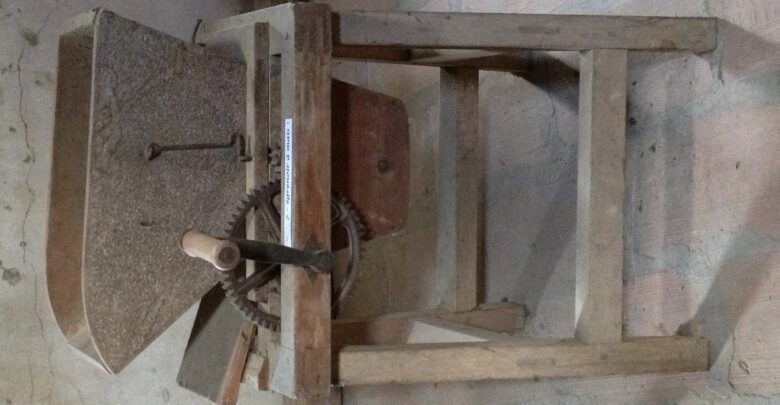
It looks like a medieval gadget bolted to a wooden stand. Hopper on top. Huge gear. Hand crank. Wooden legs planted on a farmhouse floor.
This is a corn sheller (French: égrenoir à maïs) — a machine built to remove dried kernels from a cob far faster than bare hands ever could.
At harvest time, farmers fed dried ears into the hopper and turned the crank. Toothed or spiked rollers tore the kernels free. Grain fell into a box or basket below; the empty cob was pushed out. Hand-cranked shellers were common from the 19th century into the early mechanized farm era, living in barns, sheds, and utility rooms across maize-growing regions.
To modern eyes the machine looks “too intense” for food prep — because it was farm equipment for bulk work, not a countertop toy for one dinner.
Designs ranged from tiny hand-held shellers to bench models and huge belt-driven machines. The wooden example in the photo sits in the middle: human-powered, sturdy, and built to outlast its owner.
Fun fact: Once you learn the name, you start recognizing cousins in antique shops — same crank logic, different sizes.
Shelling by hand can blister fingers after only a few baskets. That pain is why crank shellers spread so widely once metalworking and wooden joinery made sturdy home machines affordable for ordinary farms.
In French museum labels you will often see égrenoir à maïs written right on the stand — a small clue that turns a “weird crank machine” into a harvest essential.
Want more farm mysteries? Tell us which object to feature next.
Sources
- https://commons.wikimedia.org/wiki/Category:Corn_shellers
- https://commons.wikimedia.org/wiki/File:Maison_Delorme_-_%C3%A9grenoir_%C3%A0_ma%C3%AFs.JPG
Image credit: CC0 (Benoît Prieur). Source: https://commons.wikimedia.org/wiki/File:Maison_Delorme_-_%C3%A9grenoir_%C3%A0_ma%C3%AFs.JPG