A 22.82-acre equestrian farm in Madisonville, Tennessee, with two homes, a seven-stall barn, a riding arena, and Smoky Mountain views, offered at $650,000 with an assumable 5.24% VA loan.
Some listings are built around a house. This one is built around a way of life.
At 598 Griffith Branch Road in Madisonville, Tennessee, the house is only part of the story. There is a second residence, a working horse barn, a full riding arena, paddocks, a creek, fencing all the way around, and close to twenty-three acres of East Tennessee countryside with the Smoky Mountains on the horizon.
And the sellers have done something you rarely see in this market. They are offering an assumable VA loan at 5.24%, plus a rent-to-own option.
Let’s walk through the whole property, piece by piece.
Property Overview
- Price: $650,000
- Address: 598 Griffith Branch Rd, Madisonville, TN 37354
- Total bedrooms: 5
- Total bathrooms: 3
- Total living space: about 2,560 square feet across two residences
- Main home: 3 bedrooms, 2 baths, 1,920 square feet
- Second residence: 2 bedrooms, 1 bath, 640 square feet, attached to the barn
- Year built: 2005
- Lot size: 22.82 acres
- Barn: 38×40 feet, 7 stalls, expandable to 10
- Riding arena: 280×120 feet
- Roof: metal
- Financing: assumable 5.24% VA loan or rent-to-own option
- County: Monroe County
The First Impression
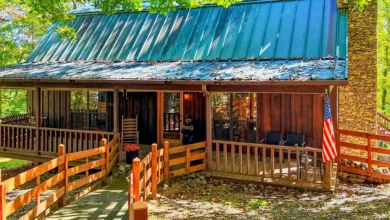
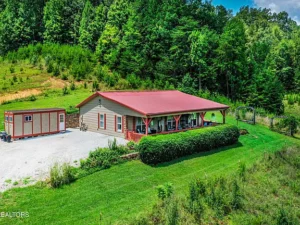
The main home is a single-story ranch built in 2005. That alone matters. You are not looking at a century-old farmhouse with mystery wiring and a fieldstone foundation.
It is a newer home, well kept, with the big systems already updated.
Then there is the porch. A 10×40 covered front porch runs across the house and faces the mountains. Forty feet of shaded space is enough for rocking chairs, a dining table, and room left over.
On a property like this, the porch is where the day starts and ends.
The Smoky Mountain View
The listing describes the mountain views as year-round. That detail is worth more than it sounds.
Plenty of rural properties advertise views that disappear the moment the trees leaf out in spring. A year-round view means the sightline holds through every season.
Views like this are one of the few things you cannot add to a property later. You either have them or you don’t.
The Living Room
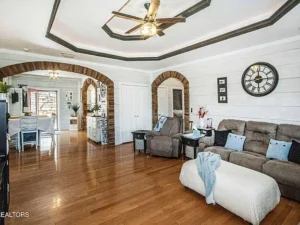
Inside, the main home has whitewashed pine walls and 9.5-foot ceilings.
Whitewashed pine gives a room warmth without making it dark. Traditional knotty pine can feel heavy. The lighter wash keeps the wood grain but brightens everything.
The tall ceilings help too. Standard ceilings are eight feet. That extra foot and a half makes a ranch home feel more open than its square footage suggests.
The Kitchen
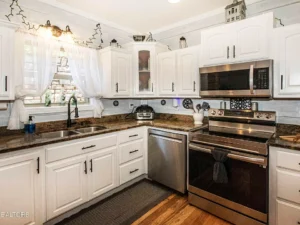
The listing notes newer appliances.
For a buyer, that means one less line item on the move-in budget. Appliances in a farmhouse kitchen take real use, and replacing a full set can easily run into the thousands.
When you tour, check the cabinet layout, counter space, and storage. On a working farm, the kitchen tends to be the busiest room in the house.
The Primary Suite
The primary bedroom is the clear standout of the interior.
It has a trey ceiling, which is a recessed, stepped ceiling that adds height and detail. It has two walk-in closets, not one. And the bathroom has a walk-in shower.
Double walk-in closets are a feature buyers usually expect in much larger, much more expensive homes. Here it comes in a 1,920-square-foot ranch.
The Other Bedrooms
The main home has two more bedrooms beyond the primary suite.
That gives you room for children, a guest room, or a home office. On a property this size, many owners turn one bedroom into a farm office for feed records, vet paperwork, and boarding contracts.
The Bathrooms
There are two full bathrooms in the main house and one more in the second residence, for three total.
For a family home, two baths in a three-bedroom house is the comfortable standard. The third bath in the guest residence means visitors are never sharing yours.
The Roof
The house has a metal roof.
This is one of the best features on the list. A properly installed metal roof can last decades longer than asphalt shingles. It sheds rain and snow well and holds up in the storms East Tennessee sees in spring and summer.
Ask the sellers when it was installed and whether any paperwork or warranty transfers.
Heating and Cooling
The HVAC system is listed as newer.
That is a big deal. A full HVAC replacement is one of the most expensive surprises a new homeowner can face. Having it already done takes a large risk off the table.
Request the install date and any service records.
The Water Heater
The water heater has also been replaced.
It is a small item compared to the roof or HVAC, but it adds up. Roof, HVAC, water heater, and appliances are the four things buyers most often end up replacing in their first few years. Here, all four have been addressed.
The Second Residence
Attached to the barn is a separate home with 2 bedrooms, 1 bathroom, and 640 square feet of space.
It has its own 40-foot covered porch, so it feels like a real home, not an afterthought.
This residence opens up a lot of options. It could house aging parents. It could be a guest house. It could be quarters for a barn manager or farm hand. Or it could be rented out.
Living space attached to a barn is a classic setup on horse farms. Whoever lives there is never more than a few steps from the animals, which matters during foaling season, bad storms, or a sick horse in the middle of the night.
The Barn
The barn measures 38×40 feet and has 7 stalls.
According to the listing, it can be expanded to 10 stalls. That gives you room to grow without building a new structure.
Every stall has electricity. The barn has hot and cold running water. And the stall mats stay with the property.
Hot water in a barn is easy to underestimate until you have it. Washing horses, cleaning equipment, and mixing feed in winter are all easier with it. Electricity at every stall means fans in the summer and heated buckets in the winter.
Stall mats are not cheap either. Outfitting seven stalls is a real cost, and here it is already done.
The Riding Arena
The arena measures 280×120 feet.
That is a generous size. It is large enough for serious training, lessons, and schooling, not just walking a horse in circles.
When you visit, look at the footing, the drainage, and the fencing around the arena. Good footing is expensive to install, and it is worth knowing what is underneath.
Paddocks and Fencing
The property has multiple paddocks and is described as fully fenced.
Fencing is one of the biggest hidden costs of starting a horse farm. Twenty-plus acres of horse-safe fencing can cost a small fortune to put up from scratch.
Walk the fence lines yourself. Note the fence type, the condition of the posts, and any sections that need repair.
The Wash Station and Covered Storage
There is a dedicated wash station for the horses and covered storage on site.
A wash station keeps grooming and bathing out of the barn aisle. Covered storage protects hay, trailers, tractors, and equipment from the weather.
These are the kinds of details that tell you the farm was set up by people who actually kept horses.
The Creek
A creek runs across the front of the property.
It adds beauty and a natural water feature. It can also add questions. Ask about flood history, whether any part of the land sits in a flood zone, and how the creek affects the driveway and fencing.
The Outbuildings
Beyond the barn, there is a new 24×8 storage shed and another large outbuilding.
On a farm, storage disappears fast. Mowers, tack, fencing supplies, feed, and tools all need a home. Extra buildings mean less clutter in the barn and less equipment sitting outside.
The Land
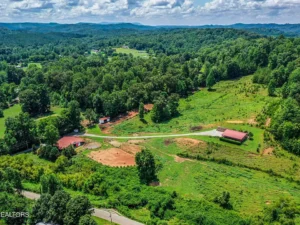
In total, the property covers 22.82 acres.
Beyond the arena, barn, and paddocks, the listing mentions plenty of usable acreage for recreation, animals, or future plans.
That could mean more pasture, a large garden, a small orchard, chickens or goats, or trails for riding. Usable land is the key word. Steep or wooded acreage is pretty, but flat or rolling ground is what you can actually work.
Utilities
The listing does not spell out the water and sewer setup.
On rural Tennessee land, buyers often find a private well or rural water line, and a septic system. With two residences and a barn using water, you will want to know exactly what serves each building.
Ask whether the second residence has its own septic or shares one with the main house, and request any septic permits or pumping records.
The Assumable VA Loan
This is the headline of the listing, and for good reason.
The sellers have a VA loan at 5.24%, and it is assumable. That means a qualified buyer may be able to take over the existing loan, rate included, instead of getting a new mortgage at today’s rate.
Here is how VA assumptions generally work.
You do not have to be a veteran to assume a VA loan. Non-veterans can assume one if the loan servicer approves them. You still need to qualify on credit and income.
The VA charges a funding fee on assumptions, typically much smaller than the fee on a new VA loan.
The biggest catch is the equity gap. You take over the remaining balance of the loan, not the full price. The difference between the loan balance and the $650,000 asking price has to be covered by you, either in cash or through a second loan.
Another point matters to the sellers. If a non-veteran assumes the loan, the seller’s VA entitlement can stay tied to it. If the buyer is a veteran who substitutes their own entitlement, the seller’s entitlement is freed up. That can affect how the sellers view different offers.
Before you get excited about the rate, ask for the current loan balance, the monthly payment, and the servicer’s assumption process and timeline.
The Rent-to-Own Option
The sellers are also open to a rent-to-own arrangement.
Rent-to-own can work well for a buyer who needs time to save a down payment, build credit, or sell another home first. You move in, pay rent, and secure the right or obligation to buy later.
The details matter a great deal. How much is the option fee? Does any part of the rent go toward the purchase? Is the future price locked in? Who handles repairs during the lease? What happens if you decide not to buy?
Any rent-to-own agreement should be reviewed by a real estate attorney before you sign. These contracts vary widely, and the fine print decides who carries the risk.
Other Financing Options
If you are not assuming the VA loan, traditional financing is still on the table, though acreage and farm use change the picture.
Conventional loans are often the most flexible for rural property, but some lenders limit how much value they will assign to large acreage or outbuildings. Expect the appraisal to be the key step.
FHA loans allow lower down payments. FHA can work on rural homes, but the appraiser will focus on the residence, and properties with significant income-producing features can face extra scrutiny.
USDA loans are designed for rural areas, and much of Monroe County may fall within eligible zones. However, USDA financing generally does not support land meant to produce income. A horse farm built for boarding or rentals may not be a fit, so ask a USDA lender before counting on it.
New VA loans are an option for eligible veterans, with no down payment required in many cases. The property must be primarily a residence.
FHA 203k loans combine the purchase with renovation funds. With this home’s major systems already updated, a 203k is less likely to be needed, but it could help if you plan to expand the barn or finish improvements to the second residence.
Farm and agricultural lenders, such as Farm Credit associations, specialize in land and rural property. They are often more comfortable with acreage, barns, and agricultural use than a typical bank.
Insurance
Insuring a horse farm is different from insuring a regular house.
A standard homeowners policy usually covers the residence, but may not fully cover a barn, arena, livestock, or business activity. You may need a farm and ranch policy instead.
If you board horses, rent stalls, or run a horse-focused Airbnb, you will likely need commercial liability coverage and care, custody, and control coverage for other people’s horses.
The second residence attached to the barn also deserves attention. Insurers often look closely at living spaces connected to barns because of hay and fire risk. Get quotes before you finalize your offer, not after.
Tennessee also has an equine activity liability law. It offers some protection to horse professionals and property owners, but it comes with requirements such as posting warning signs and using specific contract language. Ask an attorney how it applies to your plans.
Living Here as an Owner-Occupant
For a family with horses, this property checks almost every box.
The main home is comfortable and updated. The primary suite is generous. The barn and arena are already built. The fencing is done. The guest residence gives extended family their own space.
Instead of spending years building a farm, you would be moving into one.
The daily rhythm here would be simple. Coffee on the forty-foot porch facing the mountains. Chores in the barn a short walk away. Riding in the arena in the afternoon.
Rental and Income Potential
The listing highlights several possible income streams.
The 640-square-foot second residence could be rented long-term to a tenant or barn worker.
The stalls could be rented out individually to local horse owners who need boarding.
The listing also floats the idea of a horse-focused Airbnb, where guests bring their own horses or come to stay on a working farm. Horse-friendly lodging is a real niche, especially near trail systems and national forest land.
Every one of these depends on local rules. Short-term rental regulations, zoning, business licensing, and taxes all apply. Check with Monroe County before you build your budget around rental income.
Tennessee Greenbelt
Tennessee has a property tax program known as Greenbelt, which can lower taxes on qualifying agricultural land by assessing it at its use value instead of market value.
Agricultural land generally needs to be at least 15 acres to qualify, so a property this size may be eligible.
Ask whether the land is currently enrolled. If it is, find out what is required to keep it enrolled after the sale, and whether any rollback taxes could apply if the use changes.
Possible Projects and Improvements
- Expand the barn from 7 stalls to 10
- Upgrade or refresh the arena footing
- Add run-in shelters to the paddocks
- Furnish the second residence for guests or rental
- Build a hay storage barn separate from the stalls
- Add a tack room or feed room if space allows
- Create riding trails across the back acreage
- Plant a garden or small orchard
- Add solar panels to the metal roof or outbuildings
- Install security cameras in the barn
Questions to Ask Before Making an Offer
- What is the current balance on the VA loan, and what is the monthly payment?
- Who is the loan servicer, and how long does an assumption take?
- What are the exact terms of the rent-to-own option?
- What year was the metal roof installed?
- When were the HVAC and water heater replaced?
- Is the home served by a well or public water?
- Does the second residence share a septic system with the main house?
- Has the creek ever flooded the property or driveway?
- Is any part of the land in a flood zone?
- Is the land enrolled in Tennessee Greenbelt?
- Are there any easements or rights of way across the property?
- Has the property ever been surveyed?
- Does the second residence have its own address or utility meters?
- Are there any HOA rules, deed restrictions, or zoning limits on boarding or rentals?
- Has the barn or second residence had any permits for its construction?
Inspection Is Essential
Even with updated systems, a full inspection is a must on a property like this.
Hire a home inspector for both residences. Have a well inspection and water test done if the property uses a well. Get a septic inspection, ideally with the tank pumped so the inspector can see its condition.
Have someone look at the barn’s electrical system carefully. Barns are dusty, full of hay, and home to animals that chew. Wiring problems in a barn can turn dangerous quickly.
Consider a survey to confirm the boundaries, especially with the creek along the front and fencing around the entire property.
The cost of inspections is small next to the cost of a surprise after closing.
Madisonville and Monroe County
Madisonville is the county seat of Monroe County, in the foothills of East Tennessee.
It sits between Knoxville and Chattanooga, close enough for city trips, far enough for a quiet country life. The area is known for its access to the Cherokee National Forest, the Tellico River, Tellico Lake, and the Cherohala Skyway, one of the most scenic drives in the South.
For horse owners, the nearby national forest land is a major draw, with trail riding opportunities in the mountains.
Tennessee also has no state income tax on wages, which continues to attract buyers from other states.
Local schools for this address include Madisonville Primary and Madisonville Middle.
The Price in Context
At $650,000, this property is not cheap for rural Monroe County. But it is important to look at what the price includes.
You are getting two residences, a 7-stall barn with water and power, a 280×120 arena, full fencing, multiple paddocks, outbuildings, a creek, and nearly 23 acres with mountain views.
Building all of that from scratch on bare land would take years and a large budget. Fencing alone, plus a barn and an arena, can add up fast.
The property was previously listed at a higher price, around $730,000, so the current asking price reflects a meaningful reduction.
Add in the possibility of a 5.24% assumable rate, and the monthly cost of owning this farm could look very different from a standard purchase. Run the numbers carefully, including the cash needed to cover the equity gap.
Who This Property Is For
This farm makes the most sense for a few types of buyers.
Horse owners who want a turnkey setup without building from the ground up.
Families who want room for aging parents or grown children in a separate home.
Buyers who want a property that can help pay for itself through boarding or rental income.
Veterans who could substitute their entitlement on the VA loan and lock in the existing rate.
Anyone who has been dreaming of land, animals, and a mountain view, and wants it all in place on day one.
Final Thoughts
598 Griffith Branch Road is not just a house on acreage. It is a working equestrian farm with a second home, updated systems, and creative financing that is rarely offered.
The barn, arena, and fencing are the kind of improvements that take years to build. The metal roof, newer HVAC, and newer water heater remove some of the biggest risks for a new owner. And the assumable VA loan could be a real advantage in today’s market.
As with any rural property, the details make the deal. Verify the loan terms, inspect everything, confirm the water and septic setup, and check local rules before counting on rental income.
If it all checks out, this could be one of the most complete small horse farms in the Smoky Mountain foothills.




View the full listing on Zillow
Our website is designed for informational and entertainment purposes only. We are not a real estate brokerage or licensed contracting service. We operate solely as an independent blog, curating interesting houses, DIY guides, and practical home tips found across the internet. All decisions related to real estate transactions or home renovations should be made in consultation with licensed professionals. We do not guarantee the ongoing accuracy or availability of external property listings, as market statuses change rapidly. Please use our content at your own discretion.