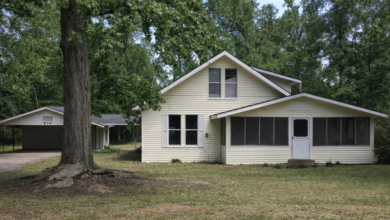
Houses
A 1924 Farmhouse on 4.8 Acres by the Water in Cedar Island, North Carolina — and Why “Under Contract” May Not Mean What You Think

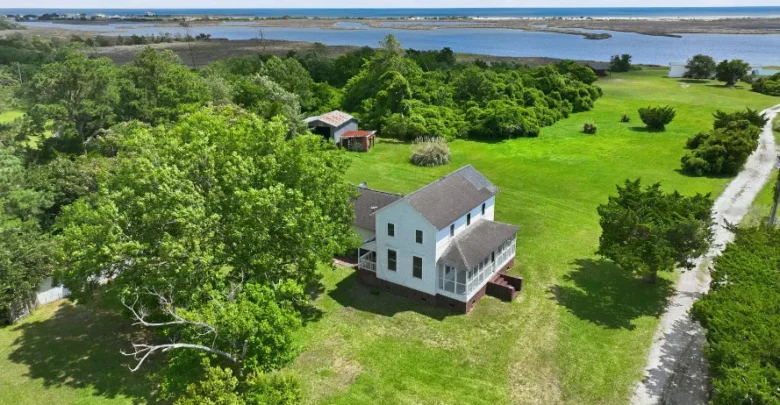
At the very end of a two-lane road in Carteret County, past the last gas station and out where the marsh grass takes over, sits a 1924 farmhouse on four and eight tenths acres of coastal North Carolina. Three bedrooms, two and a half baths, one thousand six hundred fourteen square feet, hardwood floors throughout, a screened porch on the front and another on the back. The asking price is three hundred forty-nine thousand nine hundred dollars.
It went under contract in August. Most buyers would stop reading there. In this particular case, that would be a mistake — and understanding why is the single most valuable thing in this article.
The Judicial Sale: The Detail Everyone Skims Past
The listing carries an unusual and very specific condition. The contract is subject to court approval and to the judicial sales process under Article 29A of the North Carolina General Statutes. The agent requires that language in writing on every offer submitted.
Here is what that actually means in plain English. This is not a normal private sale between two parties. It is a court-supervised sale, typically arising from a partition action among heirs, an estate administration, or a similar proceeding. Under North Carolina’s judicial sales framework, the process works fundamentally differently from a conventional transaction:
- The court must approve the sale. A signed contract is a proposal, not a closing.
- There is an upset bid period. After a report of sale is filed, North Carolina law provides a window — generally ten days — during which any qualified party may submit a higher bid meeting statutory increase requirements.
- Each upset bid restarts the clock. A new ten-day period opens after every successful upset bid, and this can repeat.
- A deposit is required with an upset bid, typically calculated as a percentage of the bid amount under the governing statute.
The practical consequence is enormous. On a judicial sale, “under contract” does not close the door the way it does on a standard listing. Until the upset bid period has fully expired and the court has confirmed the sale, a serious buyer with financing in place and a real estate attorney on retainer may still have a path.
Anyone interested should contact the listing brokerage immediately to confirm the current status of the report of sale and whether the upset period remains open. Timing here is measured in days, not weeks.
The House Itself: A Century of Coastal Farmhouse
Built in 1924, this is a one-and-a-half story wood-frame farmhouse with wood siding on a brick and mortar foundation over a crawl space, topped with a shingle roof. It is exactly the vernacular architecture that defines Down East Carteret County — practical, elevated, built by people who understood that they lived on the edge of a sound.
Layout
The main floor carries the living room, dining room, kitchen, and the primary bedroom. Two additional bedrooms sit upstairs under the roofline. Having the primary suite on the first floor is a genuine advantage in a home of this age — it means aging in place is possible without a renovation, and it makes the upstairs available for guests, children, or short-term rental use without disrupting the owner’s daily routine.
The Porches
Both the front and rear porches are screened. On the North Carolina coast, that word matters more than any granite countertop ever will. Screened porches in this region are not a luxury feature; they are how you use the outdoors between May and October without donating blood to the local mosquito population. Two of them means a morning porch and an evening porch, oriented for different light and different breezes.
Interior Details and Systems
- Hardwood floors throughout, with tile in the bathrooms
- Walk-in closets and ceiling fans
- Blinds and window treatments in place
- Heat pump providing both heating and cooling
- Appliances included: gas range, refrigerator, dishwasher, washer, and dryer
- Laundry located in the kitchen area with a dedicated closet
There is no fireplace and no basement — standard for coastal construction, where high water tables make below-grade space impractical.
The Honest Part
The listing states plainly that the house needs some TLC, and the sale is strictly as-is. That phrase, on a hundred-and-two-year-old wood-frame house near salt water, deserves respect rather than optimism. It means the buyer inherits every condition issue without recourse, and it is precisely why the listing terms are cash or conventional financing only — government-backed loan programs impose minimum property standards that as-is judicial sales frequently cannot satisfy.
The Land: Nearly Five Acres of Coastal Privacy
Four and eight tenths acres in a place like Cedar Island is a different proposition than four acres inland. Look at what surrounds it: neighboring parcels on this same road are assessed between roughly twenty thousand and sixty-six thousand dollars for half-acre to one-acre lots. Land here has value on its own.
The parcel has a water view and is unzoned, which in Carteret County means significant freedom in how an owner uses the property. Existing improvements include a storage shed and a covered farm structure sized for tractor or boat storage — the latter being genuinely valuable in a place where nearly everyone owns a boat and almost nobody has anywhere dry to put it.
Utilities are well water and septic tank. There is no homeowners association, no dues, and no architectural committee.
Cedar Island: The End of the Road, and the Start of Something
Cedar Island is one of the last genuinely remote places on the North Carolina coast. It sits at the far eastern end of the Down East communities, surrounded by the Cedar Island National Wildlife Refuge — more than fourteen thousand acres of brackish marsh, pocosin, and maritime forest that will never be developed.
The property sits minutes from the Cedar Island Ferry terminal, where the state-run ferry crosses Pamlico Sound to Ocracoke Island. That ferry is the reason a steady stream of travelers passes through this small community every single day of the season.
What draws people here:
- Some of the best fishing on the Atlantic coast, both inshore and in the sound
- Kayaking through protected marsh creeks
- Boating with immediate sound access
- Extraordinary birding in the wildlife refuge, particularly during migration
- The wild horses that roam the Cedar Island area
- Sunsets over the water that people drive hours to photograph
The trade-off is real and should be stated clearly. This is remote. The walkability score is essentially zero. The nearest elementary school is nearly nine miles away; the high school is more than twenty-four. Grocery runs are a planned event, not an errand. Hurricane evacuation is a serious consideration, not an abstraction. For the right buyer, every one of those is a feature rather than a defect.
The Numbers
Price and Valuation
At three hundred forty-nine thousand nine hundred dollars for one thousand six hundred fourteen square feet, the price per square foot runs about two hundred seventeen dollars. That number looks high until you remember what is actually being sold: this is a land-and-location purchase with a house included, not a house purchase with a yard attached.
The automated valuation estimate sits near three hundred thirty-six thousand two hundred dollars, with a range from roughly three hundred nineteen thousand to three hundred fifty-three thousand — placing the asking price at the upper edge of estimate but within range. The property last sold in December of 2010 for one hundred fifty-nine thousand dollars.
Market interest has been strong. In seventy-two days the listing drew nearly nineteen hundred views and one hundred fifty-five saves before going under contract.
Taxes
The most recent annual property tax bill was approximately one thousand two hundred fifty-six dollars against an assessed value of two hundred ninety-three thousand fifty-three dollars. Buyers should note that the assessment jumped sharply in the most recent revaluation cycle, more than doubling from the prior year’s figure — a reflection of how quickly coastal Carolina land values have moved.
Insurance: Budget Seriously
This is the line item that surprises inland buyers most, and on Cedar Island it cannot be underestimated. Coastal Carteret County property typically requires a layered insurance approach:
- A homeowners policy, which in coastal zones often excludes wind and hail entirely
- Separate windstorm coverage, frequently placed through the North Carolina Insurance Underwriting Association, commonly called the Beach Plan
- Flood insurance, through the National Flood Insurance Program or a private carrier — effectively mandatory here regardless of lender requirements
Before making any offer, obtain the FEMA flood zone designation for the structure itself, request an elevation certificate, and get written quotes for all three coverage types. On a 1924 wood-frame house near the sound, the combined annual premium can be a four-figure number that materially changes the ownership math.
Income Potential
Rental estimates for this property run around twenty-four hundred forty dollars per month. But the more interesting angle is short-term rental. The combination of ferry traffic, refuge birding, wild horses, world-class fishing, and near-total absence of hotel inventory in the immediate area creates a genuine market for a restored coastal farmhouse.
Carteret County and the Down East communities have their own rules regarding short-term rental operation, and insurance carriers require specific endorsements for rental activity. Verify both in writing before building a business case on it.
Due Diligence for a Coastal 1924 Farmhouse
- Full structural inspection with attention to sill plates, floor joists, and pier condition in the crawl space
- Crawl space moisture, ventilation, and encapsulation assessment
- Termite and wood-destroying organism inspection, which is critical in this climate
- Complete electrical evaluation and panel capacity review
- Well water potability and salinity testing
- Septic system location, inspection, and pumping records
- Roof age and remaining service life
- Lead paint and asbestos testing, standard for pre-1978 construction
- Survey confirming boundaries against the recorded lot dimensions
- Full title search with owner’s title insurance — non-negotiable on a judicial sale
- Flood zone determination and elevation certificate
The Bottom Line
Nearly five acres of unzoned coastal land with a water view, two screened porches, hardwood floors, a boat structure, and a century-old farmhouse that has already outlasted almost everything built around it — a few minutes from the Ocracoke ferry, surrounded by fourteen thousand acres of protected wildlife refuge.
It needs work, it sells as-is, and the sale runs through a courtroom rather than a closing table. For a buyer who understands upset bids, budgets honestly for coastal insurance, and wants to own a piece of the last quiet stretch of the North Carolina coast, that is a set of obstacles worth clearing.
The clock, however, is a real one. Anyone considering it should be talking to the listing brokerage and a North Carolina real estate attorney this week, not next month.