Houses
This 1856 Farmhouse in Cherry Valley, New York Was Once Part of a Hop Farm and Sits on 12 Acres With Original Georgia Pine Ceilings

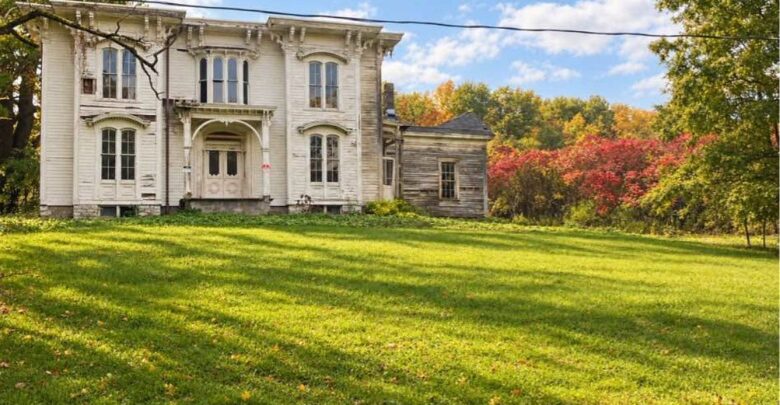
Every so often a listing shows up that makes thousands of people stop scrolling at the same moment. This one did exactly that. A tall white farmhouse built in 1856 stands at the top of a sloping green lawn in Cherry Valley, New York, framed by maples that turn red and gold every October. It sits on roughly 12 acres, it has seven bedrooms, and it was once the center of a working hop farm in the county that grew more hops than anywhere else in America. In less than two weeks on Zillow it has pulled in more than 6,500 views and well over 400 saves, which is the kind of attention usually reserved for mansions and celebrity homes.
The difference is that this house is not polished. It has been sitting empty for about 15 years, and the owner is refreshingly honest about that. What it offers instead is something money cannot easily reproduce: original proportions, old-growth wood, a commanding setting and a story that goes back to the golden age of upstate New York farming. If you love historic houses, you will want to see every photo of this one. You can browse more homes like it in our Houses collection.
A Farmhouse That Looks Like a Country Villa
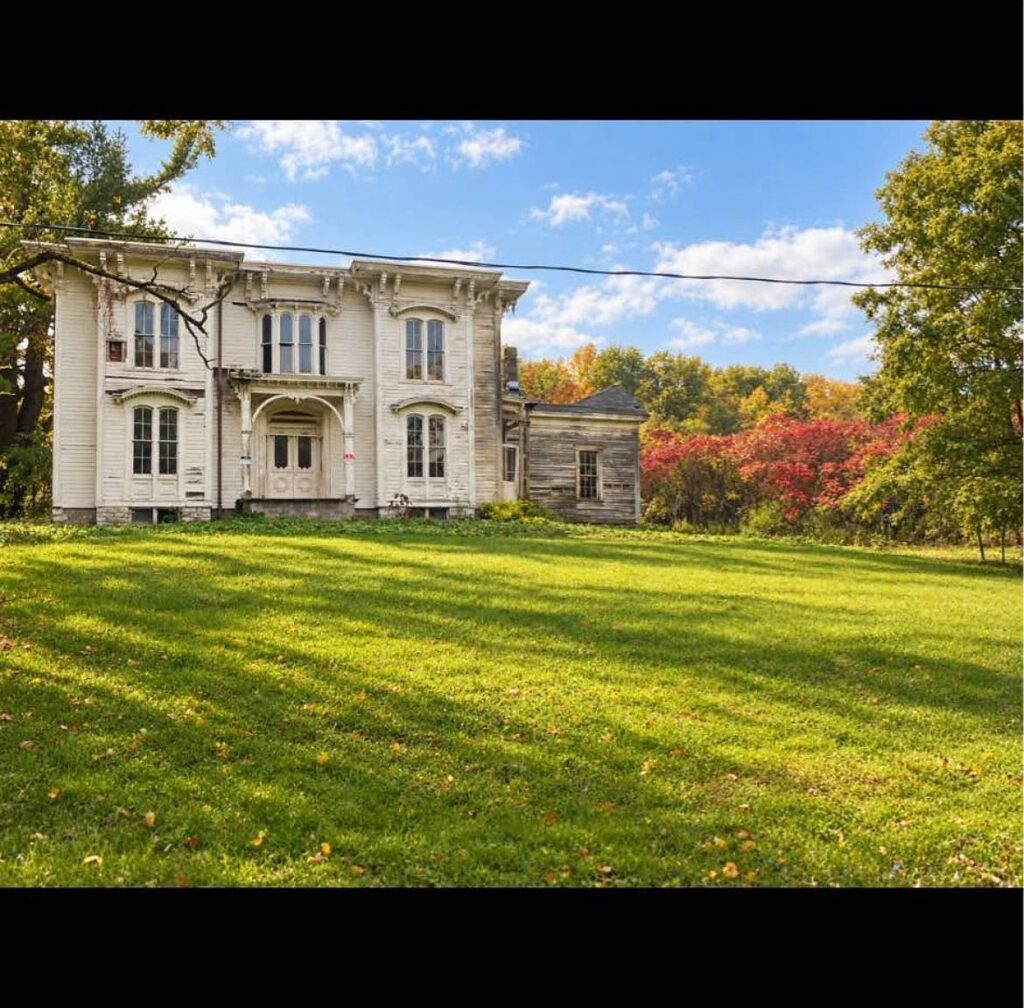
The first photo tells you most of what you need to know. The house is two full stories tall, painted white, with tall paired windows arranged in neat rows across the front. A small entry porch sits at the center, and the roofline carries the kind of deep, bracketed eaves that builders loved in the middle of the nineteenth century. To the side, an older weathered wing in silver-gray clapboard leans into the trees, adding a bit of mystery to the picture.
Houses with this look were built by farm families who had done well and wanted their homes to show it. In the 1850s, a prosperous farmer in central New York did not want a plain box. He wanted height, symmetry, generous windows and a front facade that could be seen from the road. That is exactly the impression this house still gives today, even after years without anyone living in it.
The lawn in front is wide and open, rolling gently down toward the camera. Behind and beside the house, the trees are thick and colorful, with bright red foliage that glows in the autumn photos. It is the sort of image that makes people imagine a porch swing, a long gravel drive and a lifetime of fall afternoons.
Born From the Hop Boom of Otsego County
The owner describes the property as a former hop farm, and that detail matters more than it might first appear. In the nineteenth century, Otsego County and the surrounding hills of central New York were the hop capital of the United States. Hops are the flowering vines used to flavor beer, and for decades the farms around Cooperstown and Cherry Valley grew them on a massive scale. Tall poles and wires stretched across the fields, and every late summer whole communities turned out for the hop harvest.
The money from hops built many of the handsome farmhouses that still dot the region. Families who had planted the right crop at the right time put their profits into bigger homes, better barns and fine interior woodwork. When disease, pests and Prohibition eventually wiped out the industry, many of those houses were left behind as quiet reminders of a booming past. This one is part of that story, and owning it means owning a small piece of agricultural history.
We have featured several other farm properties with deep roots, including this 1881 Pennsylvania farmhouse on 120 acres and this 1895 Downeast farmhouse on 15 waterfront acres. The Cherry Valley house is older than both.
About 12 Acres of Open Lawn, Woods and Views
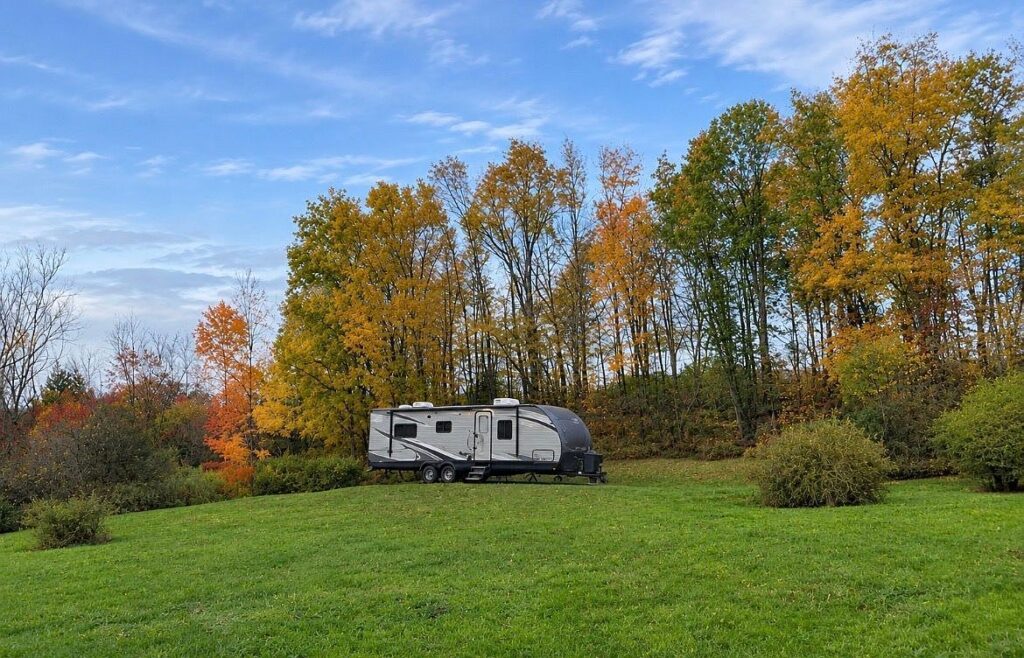
The land is a big part of the appeal. According to the listing, the parcel covers roughly 12.66 acres. The photos show open grass, stands of hardwood trees and wide skies, and the owner mentions beautiful views and land that is suitable for hunting. One image shows a camper parked at the edge of the clearing with a wall of orange and yellow trees behind it, which gives a good sense of how much room there is to spread out.
That much acreage opens up plenty of possibilities. A new owner could restore the lawn into a proper estate setting, plant gardens and orchards, bring back a small hop yard as a nod to the property’s past, or simply leave much of it wild for privacy and wildlife. Cherry Valley is a rural village, so neighbors are not on top of you, but the setting is not remote in the way some backcountry properties are.
The owner also notes that an adjoining lot of about 6.5 acres with a ranch-style home is listed separately. For a buyer who wants a larger compound, or who would like to live in one house while restoring the other, that could be an interesting option to explore with the seller.
Inside: Georgia Pine Ceilings and Original Doors
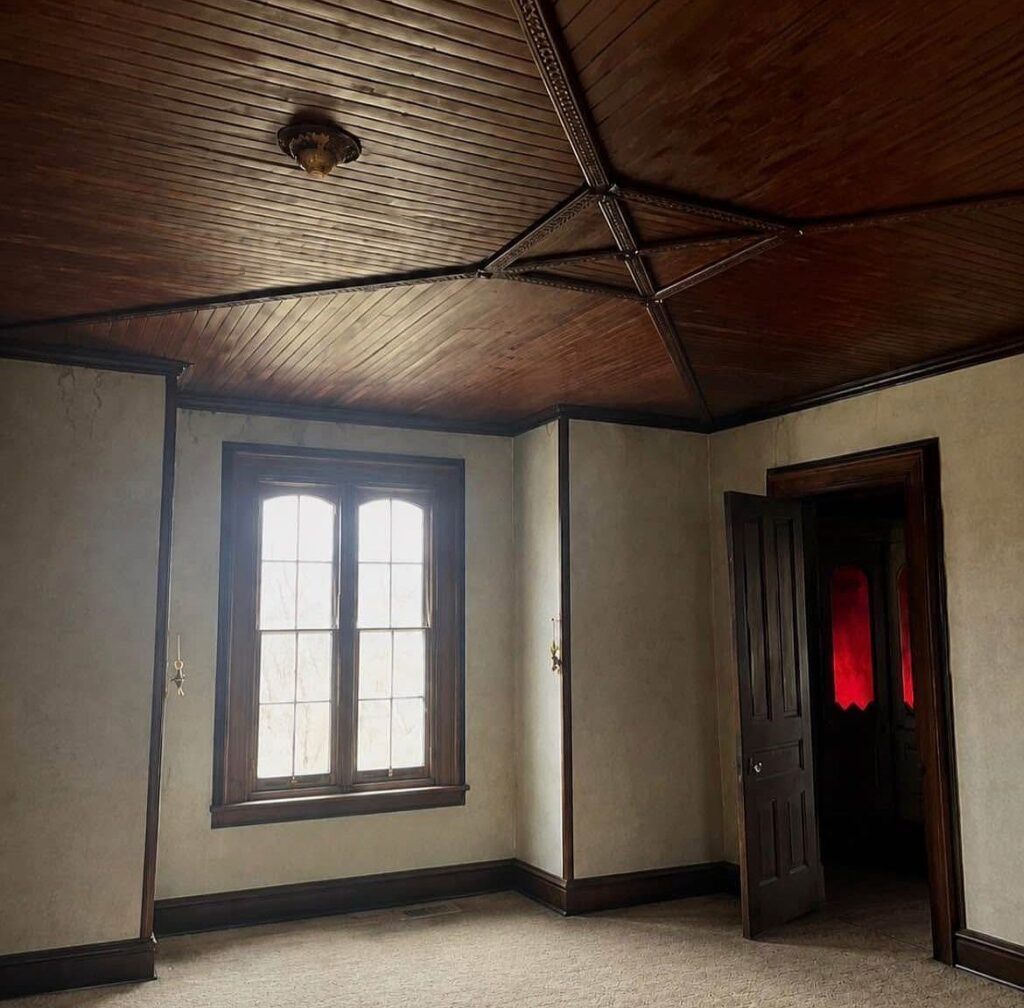
The interior photos show a house that is empty and worn, but full of original character. One of the most striking details is the ceiling in one of the rooms. It is covered in narrow boards of dark wood laid in a geometric pattern, with diagonal ribs meeting near the center. The listing calls out high Georgia pine ceilings, and in the photos the wood still has a deep, warm color after more than a century and a half.
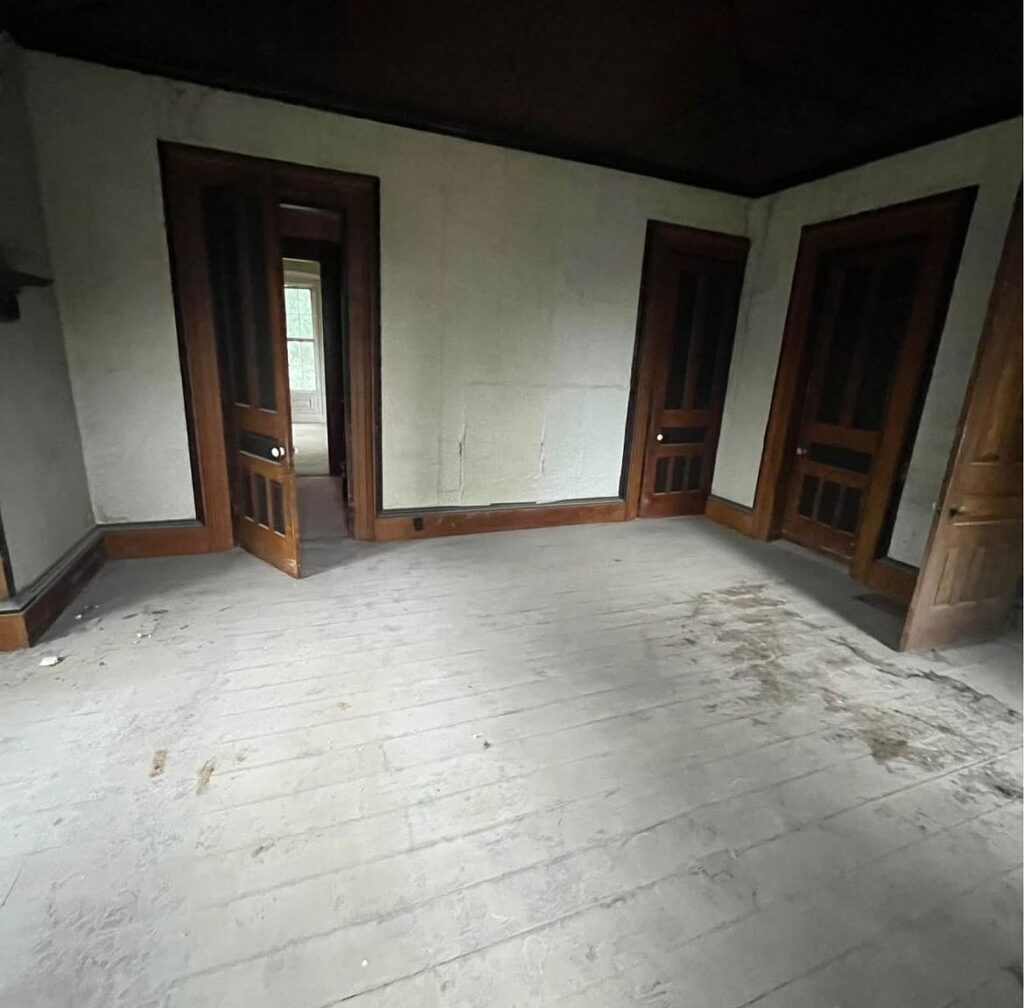
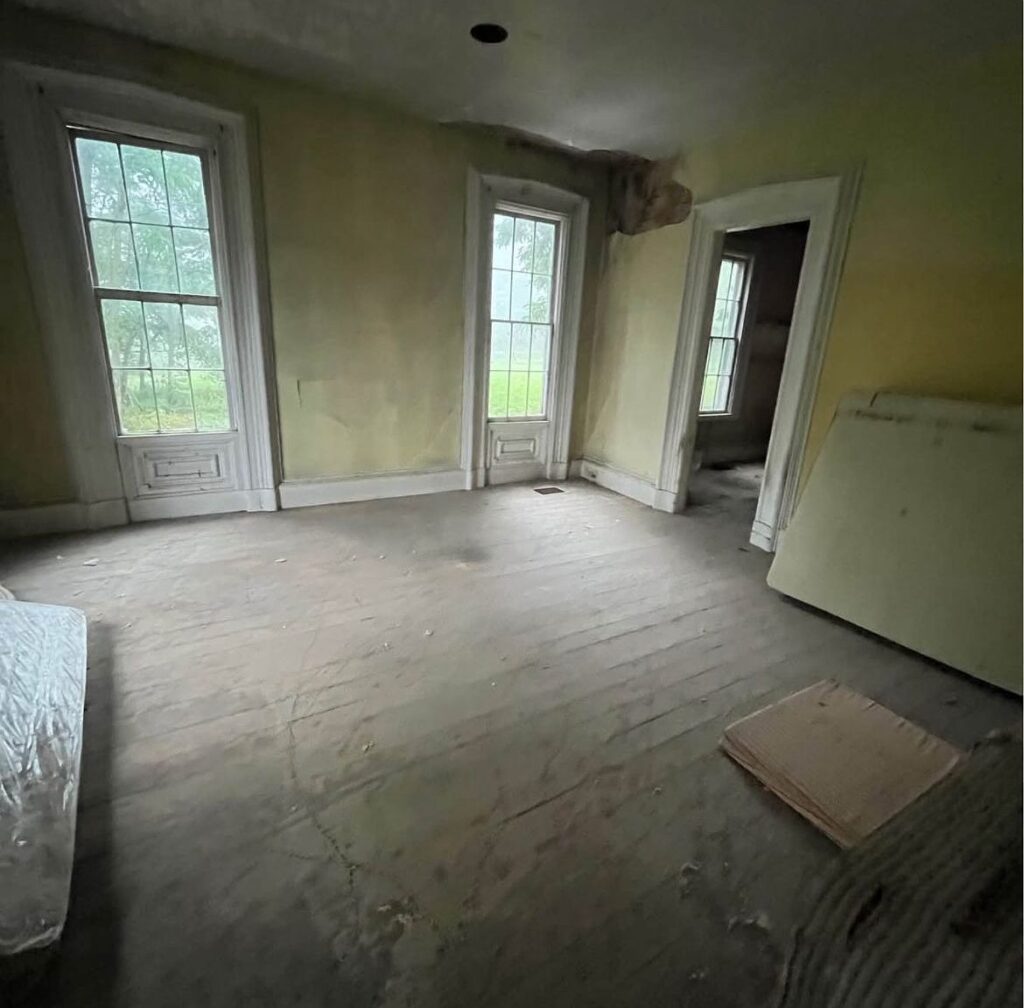
The rooms are tall, and the windows are large and tall to match. Several photos show heavy wooden doors with dark original finishes and simple, solid trim around them. Floors are dusty and some walls need attention, but the bones are easy to see. These are big, square, generous rooms of the kind that are very hard to find in modern construction.
With seven bedrooms and about 2,828 square feet of living space, the house has room for a large family, a home office or two, guest rooms and hobby space. Right now it has one full bathroom, so most buyers would likely plan to add at least one more as part of a renovation.
Honest About the Work It Needs
What makes this listing stand out is the owner’s candor. The house has been unoccupied for around 15 years. The seller says plainly that it is not move-in ready. The utility room addition has a bad roof. The exterior boards on the side that faces the sun have weathered. The condition of the power, the water system and the heating is listed as unknown.
On the other side of the ledger, the owner describes the house as having great bones and a foundation said to be about five feet thick. For an old farmhouse, a strong foundation and a solid frame are the most important things to get right, because they are the most expensive to fix. Everything else, from wiring to plumbing to paint, can be planned and budgeted.
Anyone seriously interested should bring in a qualified inspector, an experienced contractor and ideally someone who knows historic homes. A property that has been closed up for years can hide surprises, and it is far better to find them before closing than after. But for the right buyer, that honesty from the seller is a good sign. You know going in that this is a project, and you can plan for it.
Why So Many People Are Saving This Listing
More than 6,500 views and over 400 saves in under two weeks is an unusual reaction for a house in a small upstate village. A few things explain it.
First, the price. The house is listed at $175,000 for seven bedrooms and about 12 acres. In much of the country, that figure would barely buy a small lot, let alone a historic home with land.
Second, the photo. That opening shot of a tall white farmhouse on a green hill surrounded by red and gold trees is the kind of image people share instantly. It looks like the cover of a novel.
Third, the dream. A lot of people quietly imagine leaving the city, buying an old house with land and bringing it back to life. This listing fits that dream almost perfectly, and it does it at a price that makes the fantasy feel briefly within reach.
If projects like this appeal to you, take a look at this 1838 Folk Victorian with a barn in Benton, Pennsylvania and this 1900 farmhouse on 11 acres in Beaver, West Virginia.
Life in Cherry Valley
Cherry Valley is a small, historic village in the northeastern corner of Otsego County. It was settled in the eighteenth century and has a main street lined with old buildings, churches and a quiet, unhurried pace. The surrounding countryside is a mix of farms, forest and rolling ridgelines.
The owner points out that the property is close to Cooperstown, home of the National Baseball Hall of Fame and Otsego Lake, one of the prettiest lakes in New York. The area also has waterfalls, hiking, wineries and vineyards, farm stands and seasonal festivals. Summers are green and mild, autumn foliage is spectacular, and winters bring real snow.
For buyers who work remotely or who want a weekend place within reach of larger cities, central New York offers a combination of space, scenery and history that is getting harder to find. Albany, Utica and Oneonta are all within driving range for shopping, hospitals and services.
What a Restoration Could Look Like
It is easy to picture what this house could become. The exterior could be painted crisp white again with the eaves and window trim highlighted. The front porch could be rebuilt with period details. The weathered side wing could be repaired and turned into a mudroom, studio or summer kitchen.
Inside, the Georgia pine ceilings could be cleaned and oiled until they glow. Original doors and trim could be stripped or refinished. Wide rooms could become a formal parlor, a library and a large farmhouse kitchen with a big table at the center. Upstairs, seven bedrooms leave room to carve out an extra bathroom or two without losing any of the house’s character.
Outside, the open lawn could become the setting for gatherings, gardens and maybe even a small hop yard, bringing the farm’s story full circle. With about 12 acres, there is also space for a workshop, a greenhouse or a small barn.
Restorations like this take time, patience and a realistic budget. They are rarely cheap. But they are also among the most rewarding projects a homeowner can take on, because at the end you have something that cannot be built new.
Key Facts at a Glance
Location: Cherry Valley, Otsego County, New York
Built: 1856
Bedrooms: 7
Bathrooms: 1
Living space: about 2,828 square feet
Land: about 12 acres (the owner describes roughly 12.66 acres)
History: former hop farm
Notable features: high Georgia pine ceilings, original doors and trim, foundation described as about five feet thick, beautiful views
Condition: unoccupied for about 15 years, needs work, utilities of unknown condition
Listing type: for sale by owner
Asking price: $175,000
Final Thoughts
This 1856 Cherry Valley farmhouse is not for everyone. It needs serious work, and the seller is upfront about that. But for someone who has been waiting for a historic home with land, real character and a story worth telling, it is one of the most compelling listings in New York right now. The setting is beautiful, the bones are strong and the history runs deep.
Listings that get this much attention rarely stay available for long, so if it speaks to you, now is the time to look closely. For more historic farmhouses and country properties, keep exploring our Houses category, including this Civil War era farmhouse in Gettysburg.
See the full listing and all photos on Zillow: 433 Salt Springville Rd, Cherry Valley, NY 13320
Our website is designed for informational and entertainment purposes only. We are not a real estate brokerage or licensed contracting service. We operate solely as an independent blog, curating interesting houses, DIY guides, and practical home tips found across the internet. All decisions related to real estate transactions or home renovations should be made in consultation with licensed professionals. We do not guarantee the ongoing accuracy or availability of external property listings, as market statuses change rapidly. Please use our content at your own discretion.