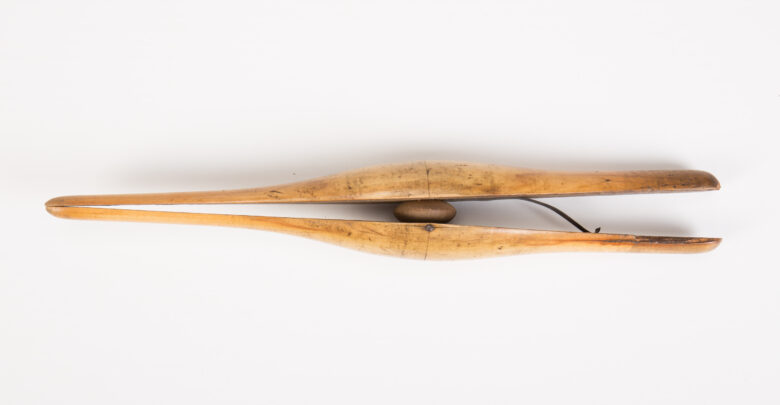
Two smooth wooden arms, a small pivot, and a metal spring. At first glance, this looks like a tool that ought to grip something. Yet squeeze its handles and the narrow ends move apart instead of closing. There are no blades, and the rounded tips are deliberately gentle.
The answer belongs to the dressing table rather than the workshop: this is a glove stretcher, a device used to ease the fingers of close-fitting gloves. Its peculiar movement was exactly what made it useful.
The user slipped the closed, narrow end into one glove finger and compressed the handles. The two wooden ends spread out inside, widening that finger so a hand could slide in more easily. The process could then be repeated on the other fingers.
Kid-leather gloves were an important fashion accessory in the nineteenth century. The National Park Service explains that their tight fit could make a mechanical aid useful, and notes that glove stretchers served men as well as women. The name “kid” refers to the leather, not to a child-sized glove.
Putting on a new pair was not the only reason to reach for this tool. Washing could leave leather gloves wrinkled and stiff. Stretchers helped restore the shape of the fingers afterward, giving the device a role in clothing care as well as dressing.
Wood was one material, but not the only one. The National Park Service also records silver, ivory, and bone examples. Its own wooden stretcher has two arms, a rounded central peg, and a spring that keeps the narrow ends together when the tool is idle.
The real object in this photograph belongs to Auckland Museum. Its catalogue identifies it as a varnished wooden glove stretcher with a metal spring and hinge. The record associates it with First World War nurse Nancy Marion Robertson, but describes that connection as a belief rather than a certainty.
That distinction matters: the photograph documents a particular surviving object, while the museum sources explain how this kind of tool worked. Neither requires an invented attic discovery or a dramatic claim about who last held it.
Once the purpose is clear, the odd shape stops being mysterious. Those smooth wooden jaws were not meant to bite, cut, or crush. They were there to make room for fingers inside a very snug piece of clothing. What was your first guess?
Sources
- https://www.nps.gov/long/blogs/glove-stretcher.htm
- https://www.rosenberg-library-museum.org/treasures/glove-stretcher
Image credit: Auckland Museum Tāmaki Paenga Hira, collection 2005.87.10 — CC BY 4.0. Photo source; license. Featured photograph only.