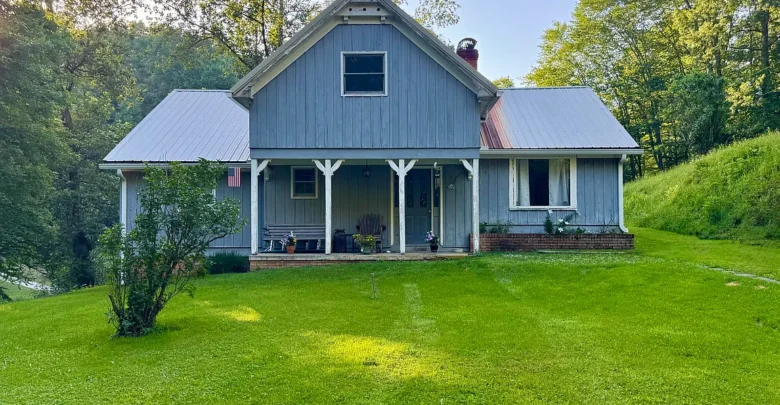
There is a certain kind of buyer who scrolls past every subdivision listing without slowing down. No cul-de-sacs. No shared driveways. No neighbor’s window twelve feet from the bedroom. For that buyer, a property like 458 Board Fork Road in Camden On Gauley, West Virginia, is not just another listing. It is the whole point.
Priced at $250,000, this 1,736-square-foot farmhouse sits on approximately 18 wooded acres in Webster County, roughly three miles from Big Ditch Lake and twenty miles from Summersville Lake. It was built in 1983, it has three bedrooms and one and a half baths, and it has no neighbors in sight. At $144 per square foot, it undercuts most of what buyers find in comparable rural markets across the Mid-Atlantic.
Here is what the listing actually offers, what it will cost to own, and what any serious buyer should verify before writing an offer.
The headline number on this property is not the price. It is the acreage. Eighteen acres of wooded land in most parts of the country would carry a land value alone approaching the full asking price here. In central West Virginia, that same acreage comes bundled with a solid, livable house.
The Zestimate on the property sits at $239,700, with an estimated sales range between $228,000 and $252,000. That places the $250,000 ask at the upper edge of the automated valuation but comfortably inside it. For context, the listing has drawn 6,158 views and 490 saves in roughly forty days on the market, and Zillow flags it as likely to sell faster than 95 percent of nearby inventory. Rural land with a house on it does not sit long when it is priced inside the estimate range.
Listed from ZILLOW
The Rent Zestimate comes in at $1,238 per month, which matters for anyone weighing this as a second property rather than a primary residence.

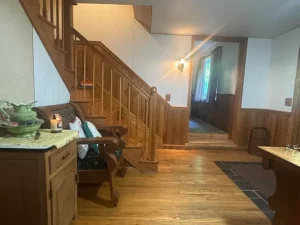
A Floor-to-Ceiling Brick Fireplace Anchors the Living Room
The single most photographed feature of this home is the fireplace. It runs floor to ceiling in brick, and it is not decorative. The property lists a wood-burning insert as part of its heating system, alongside a floor furnace.
That combination tells you something practical about the house. A wood-burning insert is dramatically more efficient than an open hearth, and in a county where firewood is effectively free if you own eighteen wooded acres, it functions as a genuine heating source rather than an amenity. Winters in this part of West Virginia are real, and a house that can heat itself off its own land carries a cost advantage that does not show up in any listing description.
Cooling is handled by window units. That is worth noting for buyers coming from markets where central air is standard. Retrofitting a 1983 frame home with central air conditioning is possible but not trivial, and it belongs on the renovation budget if year-round comfort is a priority.
The Layout: Main-Level Primary, Two Bedrooms Upstairs
The home is described as one and one half levels. The primary bedroom sits on the main floor, which is a meaningful design feature for buyers thinking about aging in place or simply preferring not to climb stairs at the end of a long day. Two additional bedrooms and a half bath are located upstairs.
Total interior livable area is 1,736 square feet. There is no basement and no garage. Flooring is listed as mixed. Included appliances are a microwave, a range and oven, and a washer and dryer. Ceiling fans are present throughout.
Construction is frame with wood siding, sheetrock interior, and a metal roof. That metal roof deserves a mention of its own. Metal roofing on a rural property typically carries a service life of forty to seventy years, compared to fifteen to twenty-five for asphalt shingle. For a buyer running the numbers on long-term ownership costs, a metal roof in good condition removes one of the largest single-line capital expenses from the next two decades.
The property condition is listed as good.

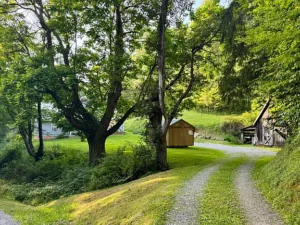
Eighteen Wooded Acres, Wildlife, and Two Lakes Nearby
The listing describes abundant wildlife across the wooded acreage, and it explicitly names hunters and outdoor enthusiasts as a target audience. Webster and Nicholas counties sit in some of the most productive whitetail and turkey habitat in the state.
Recreational access nearby is strong. Big Ditch Lake is approximately three miles away. Summersville Lake, the largest lake in West Virginia and a well-known destination for boating, scuba diving, and cliff jumping, is roughly twenty miles out.
The Walk Score for the address is zero. This is a car-dependent property in every sense. There is no walkable grocery run, no transit, and no delivery convenience. That is not a flaw in a listing like this. It is the product.
For families, the nearest schools are Glade Elementary School, serving grades pre-kindergarten through six at 2.5 miles, and Webster County High School, serving grades seven through twelve at 5.2 miles.

How to Finance a Rural Property Like This
Financing is where rural listings diverge sharply from suburban ones, and it is where buyers most often lose time. Here are the realistic paths.
USDA Rural Development Loans
This is the option most buyers overlook and the one most likely to apply here. The USDA Single Family Housing Guaranteed Loan Program offers zero down payment financing for eligible properties in designated rural areas, and rural Webster County is exactly the kind of geography the program was built for. Income limits apply and are based on household size and county median income, so a buyer should check eligibility against the USDA property and income lookup tools before assuming qualification. The guarantee fee structure is generally lower than FHA mortgage insurance over the life of the loan, which makes USDA the cheapest path to ownership for buyers who qualify.
FHA and Conventional Options
An FHA loan requires 3.5 percent down with a credit score of 580 or above, and FHA is generally more forgiving on credit history than conventional financing. The tradeoff is mortgage insurance premiums that, on most modern FHA loans, remain for the life of the loan unless the buyer refinances.
Conventional financing through Fannie Mae or Freddie Mac remains available, though rural properties on acreage sometimes trigger additional appraisal scrutiny. Appraisers working rural markets often struggle to find comparable sales, and a low appraisal on a unique property is a common reason rural deals fall apart. Buyers should build appraisal contingency language into the offer.
Buyers planning renovations should also look at the FHA 203k rehabilitation loan, which rolls purchase price and improvement costs into a single mortgage. On a 1983 home where a buyer might want to add central air, update the kitchen, or modernize the upstairs half bath into a full bath, a 203k can be more efficient than paying cash for improvements after closing.
VA Loans for Eligible Buyers
Eligible veterans and service members can pursue zero down payment financing with no monthly mortgage insurance through a VA loan. VA appraisals apply minimum property requirements, and on a rural property those requirements extend to water supply and septic systems, both of which are relevant here.
Property Taxes and Homeowners Insurance
The annual tax amount on this parcel is listed at $155. That is not a typo, and it is one of the most striking numbers in the entire listing. West Virginia carries among the lowest effective property tax burdens in the United States, and buyers relocating from higher-tax states routinely find that the annual carrying cost of rural West Virginia property is a fraction of what they left behind.
Buyers should confirm the current assessed value with the Webster County Assessor, since a sale typically triggers reassessment and the post-sale figure may differ from the seller’s historical amount.
Insuring a Rural Home with a Wood-Burning Insert
Homeowners insurance on this property will not price like a suburban policy. Three factors drive the premium. First, the wood-burning insert requires disclosure and often a certification that installation meets code. Second, distance to the nearest responding fire department affects the protection class rating, and rural addresses far from a hydrant carry higher rates. Third, replacement cost on a frame structure with wood siding needs to be calculated accurately rather than defaulted to purchase price.
Buyers should request insurance quotes during the inspection period rather than after. It is one of the most common rural closing surprises.
Due Diligence Checklist for Spring Water and Septic
Two systems on this property demand attention before closing. Water is supplied by spring, and sewer is handled by a septic tank.
Spring-fed water is common in this region and can be entirely reliable, but it is not municipal water and it carries no utility guarantee. Any buyer should commission a full water quality panel testing for bacteria, nitrates, and heavy metals, and should ask specifically about seasonal flow. A spring that runs strong in April and slows in September is a different asset than one that runs consistently year round.
Septic systems require their own inspection, separate from a general home inspection. Request the pumping and maintenance history, confirm the tank location and drain field condition, and verify the system is sized appropriately for a three-bedroom home.
The broader due diligence list should also include a boundary survey confirming the eighteen acres, a title search covering mineral rights, which are frequently severed from surface rights in West Virginia, verification of legal and deeded road access, and a general home inspection focused on the foundation, electrical panel, and plumbing on a home now more than forty years old.
Is This a Full-Time Home, a Weekend Getaway, or an Investment?
The listing pitches all three, and all three are defensible.
As a full-time residence, the low tax burden, main-level primary bedroom, and wood heat make the annual carrying cost genuinely low. As a weekend property, proximity to two lakes and eighteen acres of huntable ground is a strong value proposition for buyers within driving distance of Charleston, Morgantown, or the Virginia and Ohio suburbs. As a homestead, the acreage, spring water, and existing infrastructure remove years off a from-scratch build.
The investment case is the narrowest of the three. A $1,238 Rent Zestimate against a $250,000 purchase does not produce strong cash flow by conventional metrics, and rural rental markets are thin. This property makes more sense as a lifestyle purchase with land appreciation upside than as a rental yield play.
The Bottom Line
458 Board Fork Road offers something that has become genuinely scarce: real acreage, real privacy, and a solid house, all under a quarter million dollars. The tradeoffs are honest and visible. No garage. Window air conditioning. Spring water and septic instead of municipal utilities. A car-dependent location with a Walk Score of zero.
For a buyer who reads that list and feels relief rather than concern, this is exactly the listing they have been waiting for.
The property is listed at $250,000 by Katie Boggs of Lillywood Realty under MLS number 26-306.