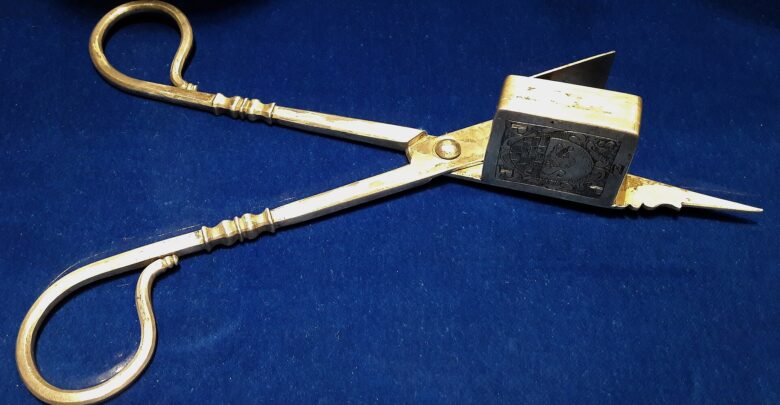
The finger loops say scissors. The pointed ends suggest something precise. But halfway along the blades sits a small metal box, positioned exactly where ordinary scissors would need an unobstructed cutting edge. Why build a container into a cutting tool?
These are scissor-style candle snuffers, also known as wick trimmers. Their job was not sewing or paper cutting. They tended the burning wick of a candle, collecting the charred piece instead of letting it drop onto the candle or surrounding surface.
Historic Jamestowne describes the mechanism through a surviving snuffer box and a modern reproduction. One scissor-like blade carried the box; the other held a plate that fitted inside it. Closing the blades cut the wick end into the little receptacle.
The arrangement explains the unusual silhouette. A pair of ordinary scissors could cut a wick, but would not necessarily contain the hot fragment. Combining cutter and catcher made the device a more specialized piece of household lighting equipment.
The pointed end had a practical role too. According to Historic Jamestowne, it could lift the wick for cutting. The tool therefore brought several small lighting tasks together in one object: positioning the wick, trimming it, and catching what was removed.
Why did people need to do this regularly? Older candle wicks did not all behave like modern self-consuming ones. Burned wick could accumulate and interfere with proper burning. Historic Odessa explains that snuffing remained a regular task until candles with wicks that burned completely became available.
Odessa’s collection includes a steel example dated 1790–1840. Its spring-operated box stayed closed so that the hot wick could not fall out and damage a tablecloth or another surface. That is a feature of that particular example, not a claim that every surviving pair used the same mechanism.
The photograph here shows an ornate silver pair in the District Museum in Toruń. Wikimedia Commons identifies its maker as Hans Marttelius and dates it to 1641–1649. The decorative engraving makes it striking, but the basic function remains a very practical one.
The surprise is not that people owned scissors centuries ago. It is how much attention everyday lighting demanded. The little box is evidence of that routine: before a lamp switch could light a room, even maintaining a candle flame called for its own carefully designed tools.
Sources
- https://historicjamestowne.org/collections/artifacts/scissor-snuffer/
- https://historicodessa.org/collections/museum/snuffer-or-wick-trimmer-1959-3904
Image credit: Photo: Artinpl / Wikimedia Commons — CC0 1.0; object by Hans Marttelius, District Museum in Toruń. Photo source; license. Featured photograph only.