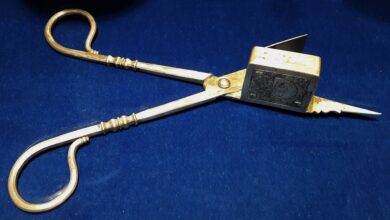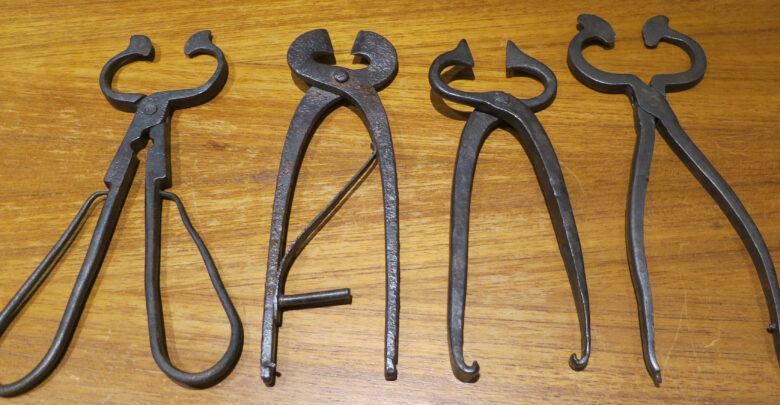
They look like scissors that went to the blacksmith and came back wrong.
Long iron handles. Short, curved jaws. No long paper-cutting blades — just a pair of hard little “beaks” that close with a crunch.
These are sugar nips (also called sugar nippers or sugar-loaf cutters).
Before granulated sugar and neat cubes were everyday groceries, refined sugar often arrived as a hard cone called a sugar loaf. Households broke off what they needed for tea and cooking. Soft serving tongs made for cubes would not do that job. Sugar nips were built to bite into the solid loaf and clip off usable lumps.
Some nips were handheld scissors-style tools, like the iron examples in the photograph. Others were heavier table models with a stand, made to tackle larger loaves on a countertop. Museum collections — from London’s social-history galleries to the Smithsonian’s domestic-life holdings — describe the same basic task: cut and break lump sugar for the household.
Sugar use rose sharply in Britain and elsewhere during the eighteenth and nineteenth centuries as production expanded. Tools like these sat in ordinary kitchens for generations. When free-flowing granulated sugar became common, the nips lost their daily job and turned into antiques that confuse modern viewers who assume every scissor-shaped tool cuts fabric or paper.
If you find a pair in a drawer, look at the jaws: they are meant for crushing and clipping hard sugar, not for cloth, hair, or stationery.
Collectors and kitchen historians still recognize sugar nips as a marker of that pre-granulated world: a time when sweetening tea meant first cutting the sugar itself.
What mystery kitchen tool should we crack next?
Once you know the name, those awkward jaws make sense: they were built for a hard cone of sugar, not for a modern sugar bowl.
Sources
- https://www.londonmuseum.org.uk/collections/v/object-53538/sugar-loaf-cutters/
- https://americanhistory.si.edu/collections/nmah_318708
Image credit: CC BY 4.0 (R. Henrik Nilsson). Source: https://commons.wikimedia.org/wiki/File:Sugar_nips_Sweden_1800s.jpg