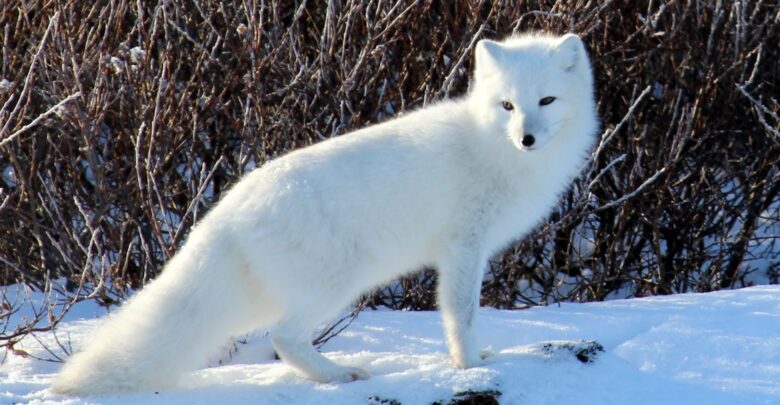
Researchers in Svalbard fitted a young female Arctic fox with a satellite collar expecting ordinary coastal movements: hunting, denning, surviving the polar year.
Instead, in 2018 she walked into the record books.
According to a peer-reviewed study in Polar Research by Eva Fuglei and Arnaud Tarroux, the fox left Spitsbergen, crossed Arctic sea ice, traversed Greenland’s ice sheet, and reached Ellesmere Island in Nunavut, Canada. From the day she left Spitsbergen to arrival in Canada she covered about 3,506 km in 76 days. Including earlier legs from her natal area, the tracked dispersal totaled roughly 4,415 km. On Greenland ice she hit a recorded peak of 155 km in a single day — the fastest movement rate documented for the species at the time.
She also switched ecosystems: born into a coastal “blue fox” food web, she settled in a High-Arctic system where lemmings matter. Later reporting noted that her transmitter eventually stopped, so her final fate remains unknown.
One small animal. One collar. Two continents. And a silence at the end that still feels unfinished.
Scientists care about journeys like hers because sea ice is both a highway and a vanishing resource. As ice patterns change, the same crossing may become harder or impossible for future foxes — turning one GPS track into a climate story as well as an adventure.
Of more than fifty Svalbard Arctic foxes tracked in related work, researchers noted that only this one completed such an extreme intercontinental run in the published account — which is why the story traveled far beyond polar science circles.
What animal mystery do you want next? Comment below.
Sources
- https://polarresearch.net/index.php/polar/article/view/3512
- https://www.nesdis.noaa.gov/news/argos-used-track-foxs-2700-mile-journey-norway-canada
Image credit: CC BY 2.0 (Emma). Source: https://commons.wikimedia.org/wiki/File:Arctic_fox_(6375703941).jpg