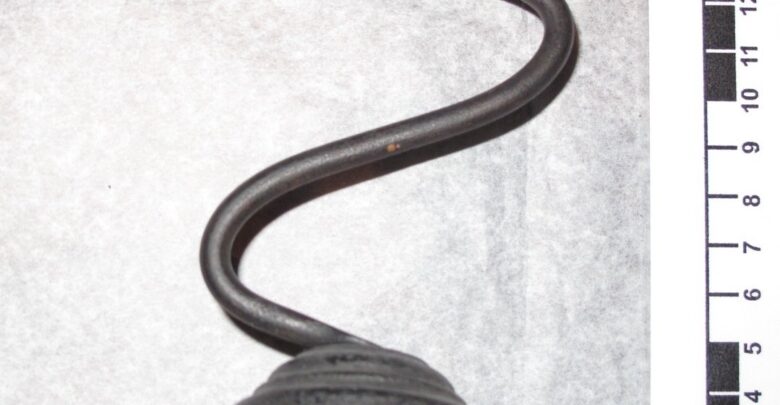
It looks too small to be an iron. Too weird to be a candle holder. Too serious to be a toy.
The answer: a goffering iron — a specialist laundry tool used to shape fine ruffles, frills, and tiny pleats.
In the 18th and 19th centuries, caps, cuffs, collars, and fashionable trims were full of delicate ridges. A regular flatiron would crush them flat. A goffering iron’s heated barrel or bullet-shaped piece let laundry workers press those ridges into place without destroying the whole garment. The metal was warmed in a fire or on a stove, set into its stand, and used carefully on damp or starched fabric.
Stands kept the hot piece stable. Wooden handles protected fingers. Households that cared about “proper” linen sometimes owned more than one size for different frills.
When clothing styles softened and laundry technology changed, goffering irons slipped out of daily life and into flea markets and museum drawers. That is why a modern shopper stares at the “egg on a stick” and feels completely lost.
Fun fact: Auckland Museum documents a goffering iron brought to New Zealand from Scotland around 1860 — proof that even tiny laundry tools traveled with migrant families.
Related tools included fluting irons and special tongs for ribbons and trims. Together they formed a lost toolkit of “detail laundry” that most modern closets no longer need — which is exactly why the goffering iron reads as an alien artifact at a flea market.
Want another laundry-room mystery? Tell us in the comments.
Sources
- https://commons.wikimedia.org/wiki/File:Iron,_goffering_(AM_1943.39-2).jpg
- https://en.wikipedia.org/wiki/Goffering_iron
Image credit: CC BY 4.0 (Auckland Museum / Commons). Source: https://commons.wikimedia.org/wiki/File:Iron,_goffering_(AM_1943.39-2).jpg