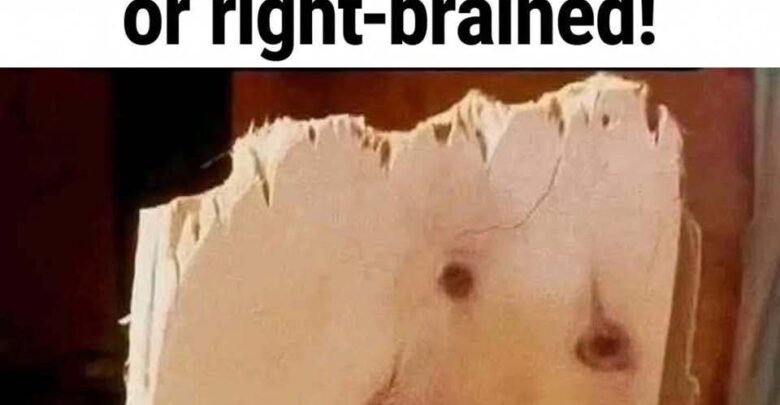
You are sitting at the kitchen counter, a warm mug of herbal tea warming your hands, when a curious photograph catches your attention. At first glance, it looks like an ordinary piece of rough-cut lumber, fresh from the workshop and splintered along the grain. Yet within a fraction of a second, your eyes lock onto the dark knots and wood rings, instantly assembling them into the face of a familiar creature.
Optical puzzles have a unique way of stopping our morning scroll. Whether you are taking five minutes between household chores or relaxing on the sofa, this viral visual personality test taps into something deeply rooted in human perception. One viewer immediately spots the perky ears of a rabbit, another catches the sleek profile of a fish, while a third insists they are looking straight at a scruffy dog.
Before we explore what each shape suggests about your daily thought habits, take one honest look at the cut of timber. What creature greeted your eyes first?
The Curious Case of the Split Timber Face
The image features a weathered piece of wood with raw, fractured edges along its top crown, two dark circular knots, and an irregular swirl positioned toward the bottom center. To an automated camera, it is merely cellulose, dried sap, and varying densities of light and shadow. To the human visual system, however, it is practically alive.
Your optic nerve does not simply capture raw snapshots and deliver them passively to your consciousness. Your visual cortex immediately begins grouping contrast lines, measuring negative space, and matching ambiguous textures against mental templates built over a lifetime. Within milliseconds, your mind stitches those timber marks into a coherent silhouette.
That immediate recognition feels instantaneous, but it is actually an impressive feat of perceptual problem-solving. Depending on where your focus first landed—the jagged splintered top, the twin dark spots, or the lower ring—your brain committed to a working hypothesis and organized the rest of the image around it.

Natural grain patterns on home wooden surfaces frequently trigger spontaneous pattern recognition.
Rabbit, Fish, or Dog: What the Folk Interpretations Suggest
Lighthearted personality tests have become beloved conversation starters around kitchen islands and living room coffee tables. While these quizzes are fun exercises in self-reflection rather than rigid scientific evaluations, they offer an entertaining way to explore our cognitive tendencies. Here is what popular interpretation says about your first glance.
The Rabbit: Broad Horizons and Intuitive Leaps
If your eyes immediately found the rabbit, you likely focused on the rough, splintered grain at the top of the wood block. Your mind translated those irregular, fibrous points into long ears resting gently back, using the upper knots as soft eyes gazing across a field.
People who spot the rabbit first are traditionally described as holistic, big-picture thinkers. You might rely on gut instincts when making everyday choices, trusting your intuition rather than waiting for an exhaustive checklist. Spontaneous DIY projects, creative baking experiments, and open-ended routines often suit your personal style far better than rigid schedules.
You also tend to connect seemingly unrelated thoughts with ease. When an unexpected hitch arises in your daily plans, you look for a creative workaround instead of forcing a stubborn solution.
The Fish: Structural Precision and Grounded Logic
Finding the fish requires your brain to interpret the wood horizontally. The rough side fractures become trailing fins, the elongated body flows along the grain lines, and the lower circular whorl transforms into an open, rounded mouth. Spotting this aquatic form means you processed directional contour before getting caught on individual central details.
This perspective is linked to a methodical, observant approach to daily life. You might be the household member who spots when a picture frame is tilted by two millimeters, or who notices the quiet hum of an appliance that needs a fresh filter. Small structural clues stand out to you clearly.
Order and sensible systems bring you genuine peace of mind. When tackling home organization or planning a busy week, you find satisfaction in clean workspaces, practical tools, and steady, step-by-step progress.
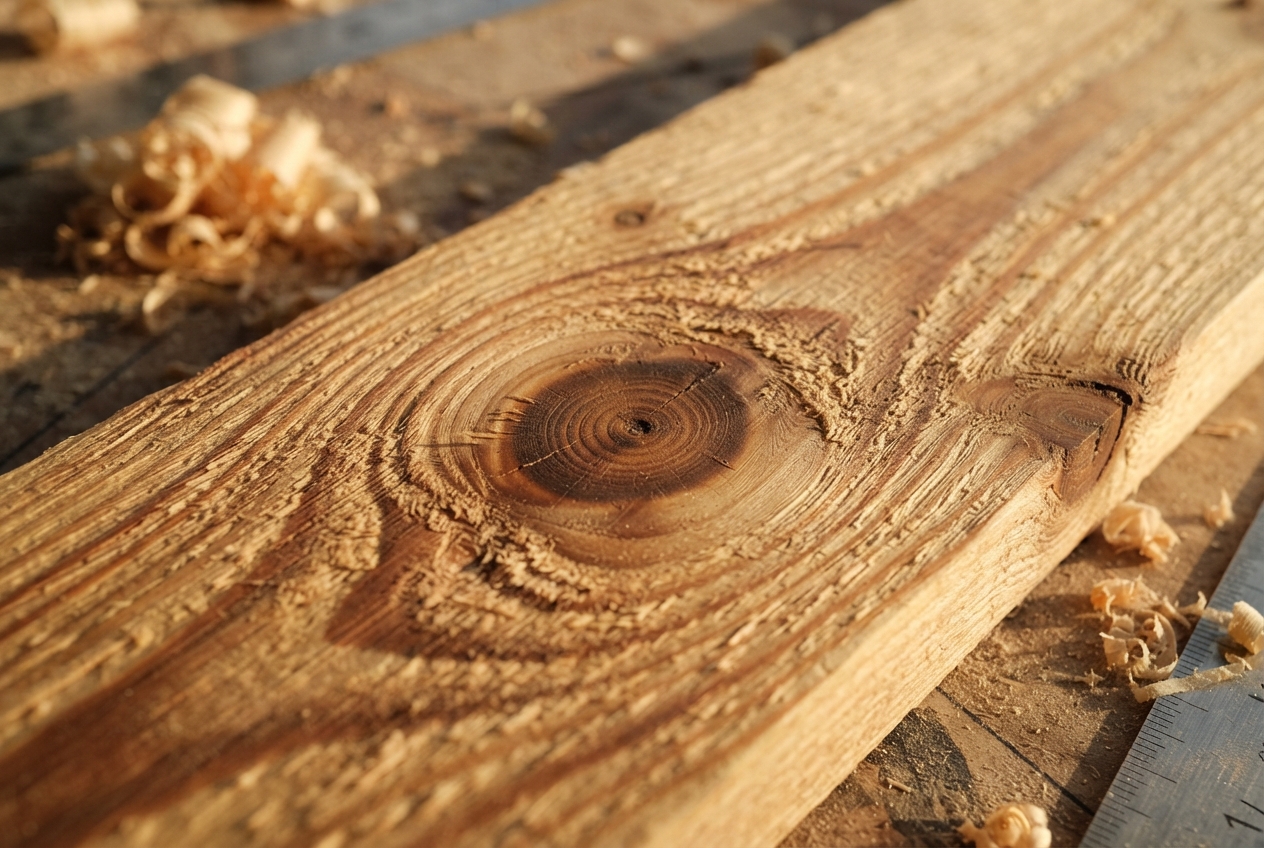
Close-up wood knots and split timber fibers provide the organic contours our eyes assemble into familiar shapes.
The Dog: Contextual Flexibility and Whole-Picture Vision
If a canine face leaped out at you right away, your visual attention anchored directly onto the lower circular mark, reading it as a snout or a wet nose. The two dark knots above immediately resolved into attentive, loyal eyes, turning the entire slab of lumber into an endearing portrait.
Folk psychology categorizes those who spot the dog as balanced, adaptable thinkers. You likely move comfortably between expansive creative ideas and grounded execution. You can map out a garden redesign in the morning and happily spend the afternoon measuring soil volumes and timber edging with equal focus.
This choice points toward high situational awareness. You read the mood of a room quickly, adjust your communication when conversations shift, and rarely box yourself into a single, stubborn perspective.
The Science Behind the Viral Visual Personality Test
Many online captions claim that this viral visual personality test determines whether your left or right brain hemisphere takes the lead. It makes for catchy trivia, but modern cognitive neuroscience paints a much more integrated picture. The notion that people are strictly “left-brained” (analytical) or “right-brained” (creative) is an outdated pop-psychology shorthand.
Your brain never works in isolated halves. The thick bridge of nerve fibers known as the corpus callosum facilitates non-stop, two-way communication between both hemispheres every millisecond. When you look at an ambiguous pattern in a cut of wood, both sides collaborate instantly.
Your visual system does not choose between cold logic and wild imagination; it coordinates spatial geometry, texture analysis, and memory recall all at once to make sense of the world.
One region evaluates the raw spatial orientation of the wood grain, while another accesses memory banks to identify familiar biological shapes. You are not witnessing a battle between logic and art. You are watching your entire brain work together as a synchronized team to resolve visual ambiguity.

Visual perception tests often spark lively living-room conversations and friendly debates over morning coffee.
Why Your Eyes Spot Faces in Tree Bark and Timber: Pareidolia Explained
If the test does not measure brain lateralization, what causes that instant flash of recognition? The answer is a universal human trait known as pareidolia. This is the psychological tendency to spot meaningful images—especially faces and living creatures—in random, inanimate patterns.
Pareidolia is the reason we see animal silhouettes in afternoon clouds, a smiling face in the headlights of a car, or expressive eyes in a pair of cedar fence knots. Far from being a glitch, it is an essential survival mechanism passed down from our earliest ancestors.
In the wild, mistaking a shadow or a cluster of leaves for a hidden predator carried zero survival cost. Failing to spot a real predator hiding in the brush, however, was fatal. Natural selection favored humans with an ultra-sensitive pattern detection system that errs on the side of seeing living beings everywhere.
A specialized structure in your temporal lobe, the fusiform face area, reacts to face-like arrangements in less than one-tenth of a second. Two dark knots positioned above an open circle trigger that circuit immediately. Your brain registers a living face long before conscious reasoning can step in and say, “Relax, it is just firewood.”

Everyday kitchen materials hold organic textures and silhouettes that reward a second, mindful look.
Breaking Visual Lock: How to Spot All Three Animals
One of the most fascinating aspects of any optical illusion is how stubbornly your brain locks onto its first interpretation. Once you see the dog, the rabbit seems to disappear. The brain values cognitive efficiency; once an ambiguous shape has been categorized, it stops hunting for alternative explanations.
To break that perceptual hold and see the remaining creatures, you have to deliberately disrupt your habitual gaze. Try these simple visual exercises:
- Soften your focal depth: Instead of staring directly at the dark knots, squint slightly and blur your vision. Dropping sharp contrast allows the outer silhouette and perimeter shapes to take precedence.
- Switch figure and ground: Consciously focus on the negative space surrounding the timber rather than the surface of the wood. Letting the background become the focal subject helps reset your pattern recognition.
- Cover the primary anchor: Place your finger over the lower circular knot. Removing the “nose” instantly weakens the dog portrait, freeing your visual cortex to see the upward sweep of rabbit ears.
- Rotate your viewing angle: Tilt your head slightly to view the grain along a horizontal axis. The vertical animal disappears, allowing the elongated fins and mouth of the fish to emerge along the lateral lines.
Practicing this visual shift is an enjoyable way to build mental flexibility. It demonstrates that when something seems fixed in place, a slight change in angle can reveal an entirely fresh reality.
A Fresh Way to View the Textures Around Us
There is real pleasure in slowing down to observe the quiet details in our living spaces. Between balancing work responsibilities, preparing meals, and organizing our homes, we often move through rooms on autopilot, seeing only the functions of objects rather than their character.
Taking a quiet moment to trace the swirls in a wooden cutting board, the veining in a stone countertop, or the knots in a garden bench pulls us back into the present. It exercises our natural curiosity in a gentle, grounding manner.
The next time you share a viral visual personality test with family or friends around the dinner table, remember that differing answers are not tests of wit or personality flaws. They are simply proof of how wonderfully flexible human perception can be, and how much fun it is to discover what someone else notices first.